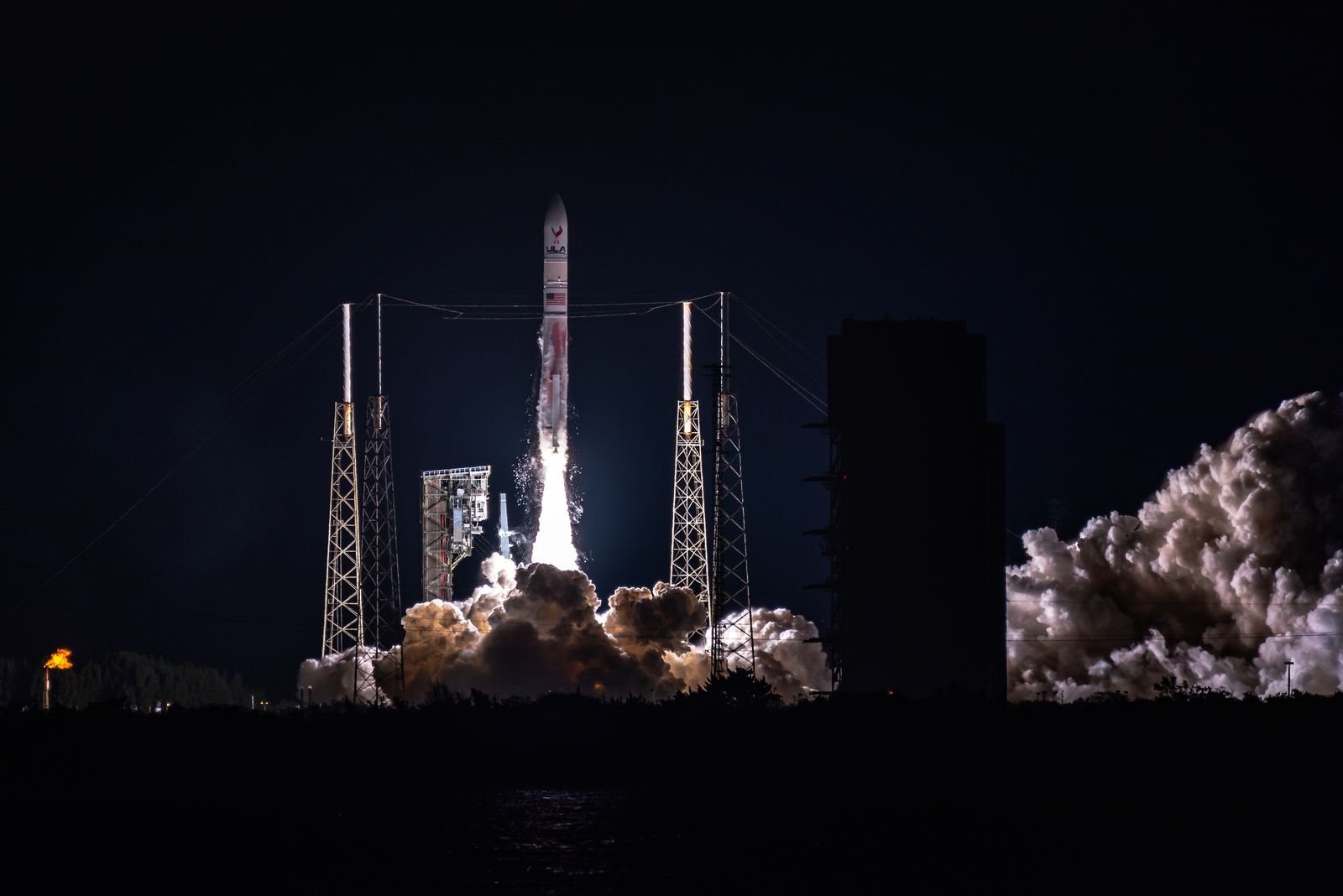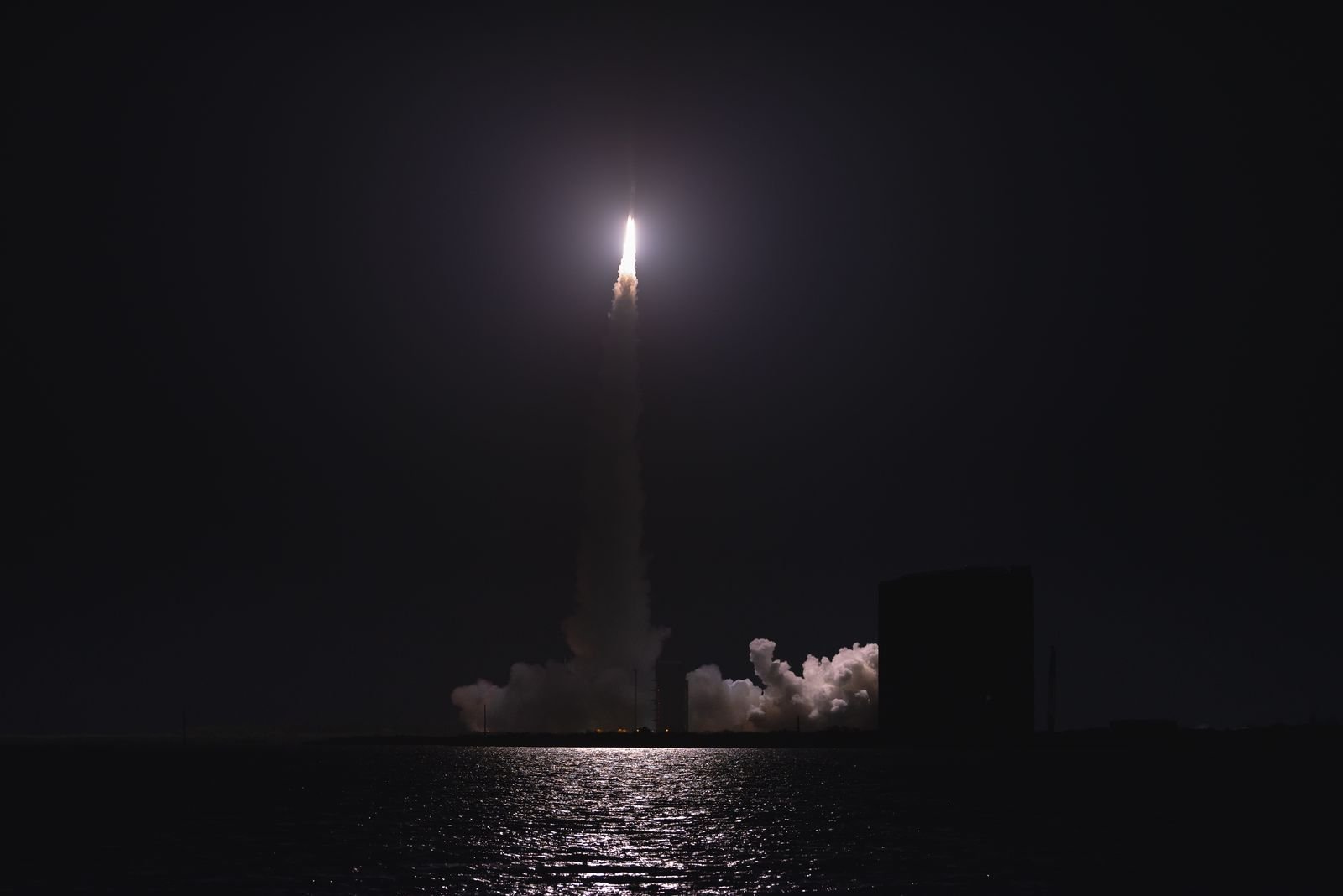
CAPE CANAVERAL, Fla. — United Launch Alliance’s Vulcan rocket lifted off from Cape Canaveral Space Force Station on Sunday, carrying 40 Amazon Leo broadband satellites toward orbit and returning the rocket to flight after a nine-month grounding. Liftoff from Space Launch Complex 41 came at 12:40 p.m. ET, at the very end of the day’s launch window, on the mission’s third attempt.
The countdown was held and rewound to T-minus 7 minutes after what ULA called a “computer-checked redline limit violation.” ULA reported the violation closed at 12:30 p.m. ET, and a fresh “go for launch” poll of launch officials was completed at 12:34 p.m. ET before the rocket was cleared to fly.
All six of the rocket’s GEM-63XL solid rocket boosters jettisoned cleanly at about one minute and 45 seconds into flight, and ULA confirmed about six minutes after liftoff that booster-engine cutoff, staging, ignition of the Centaur V upper stage and jettison of the payload fairing had all occurred, with the vehicle supersonic and past the point of maximum aerodynamic pressure. No booster or nozzle problem was reported in the early minutes of the flight.
Vulcan had not flown since February 12, 2026, when a solid rocket booster nozzle failed during the USSF-87 national security mission — the second such failure in the rocket’s first four flights. The U.S. Space Force paused Vulcan’s use for national security missions while ULA investigated, and the company redesigned the booster nozzle; this flight was the first test of the fix in flight. Friday’s attempt was scrubbed after a power interruption at an Air Liquide gaseous nitrogen plant cut power to high-pressure pumps, and Saturday’s attempt was scrubbed after a network communication issue between ground equipment and the rocket required reconfiguration that would have run past the launch window.
The mission, designated Amazon Leo LV-01, is Vulcan’s fifth flight since its January 2024 debut and the first in the six-booster VC6L configuration, the rocket’s most powerful variant. The 215-foot-tall vehicle, which generates nearly four million pounds of thrust, carries a 70-foot payload fairing and the low-Earth-orbit-optimized Centaur V upper stage. The 40 satellites are the largest batch Amazon has launched at once and the first of 38 Vulcan launches Amazon has bought to build its Leo constellation, a rival to SpaceX’s Starlink. Amazon says Vulcan will carry more than 1,500 first-generation Leo satellites across those missions, and the constellation is planned at more than 3,200 satellites.
Deployment of the 40 satellites was still to come as the rocket climbed to orbit. Centaur’s initial burn lasts about 11 minutes to reach a preliminary parking orbit, followed by a roughly 50-minute coast and a brief second engine firing near apogee to circularize the orbit at about 285 miles. The satellite deployments are scheduled to begin about 70 minutes after liftoff — around 1:50 p.m. ET — in 16 separation events over about 25 minutes as Centaur crosses the Pacific Ocean.