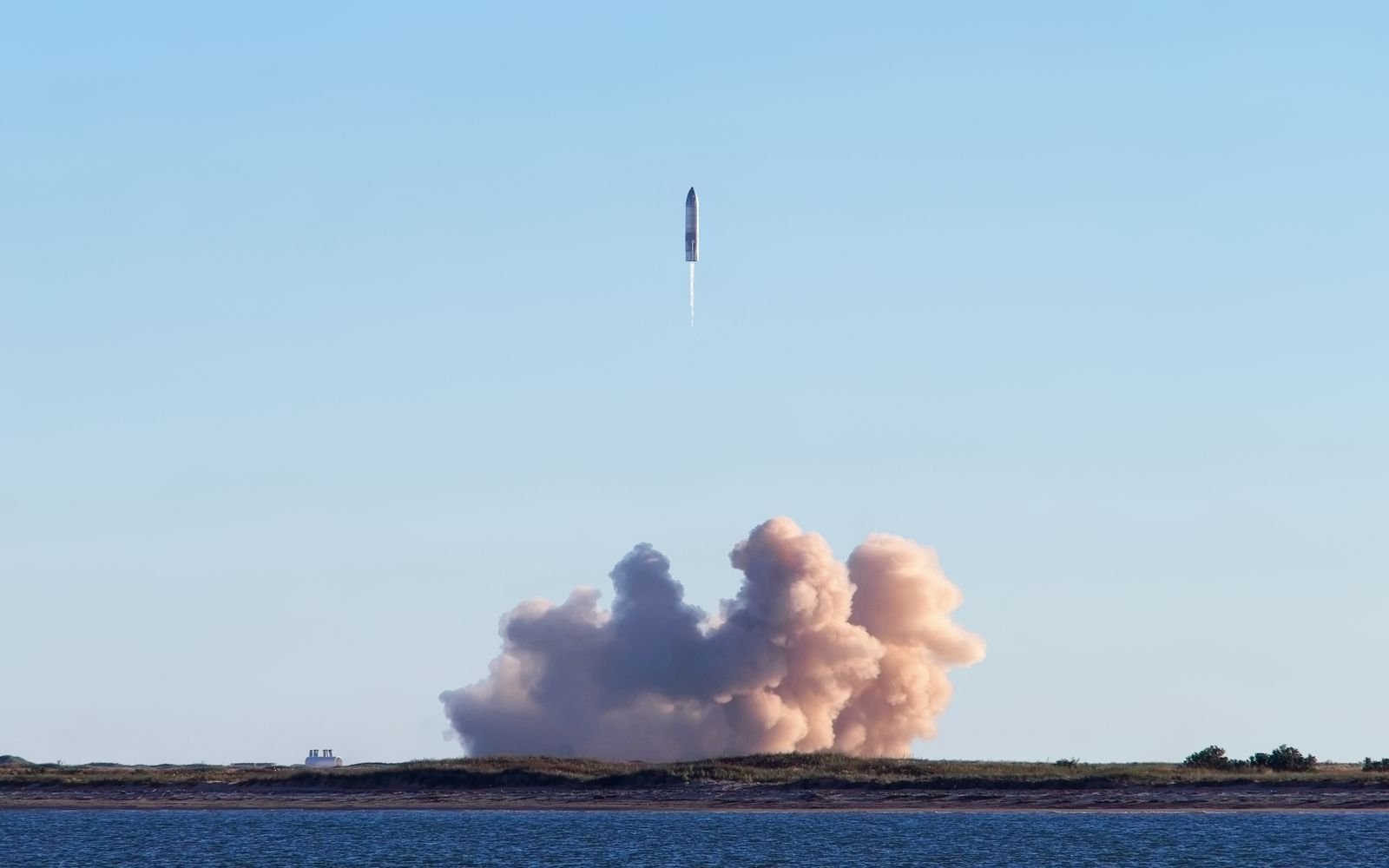
SpaceX has caught its Starship spacecraft with the launch tower's giant mechanical arms, completing the first return of a spacecraft from orbit to the exact spot from which it launched.
Ship 42, the upper stage of Starship Flight 15, came back to Earth on Saturday afternoon, roughly 23 hours after lifting off from SpaceX's Starbase facility in Texas on Friday evening. The tower's arms, nicknamed the chopsticks, caught the vehicle as it hovered over the launch pad, Barron's reported.
"A Starship spaceship orbiting Earth has returned, with the potential to be used again," Barron's wrote. "That's the first time a spaceship has returned since 2011, when NASA's Space Shuttle returned on its final flight."
The catch caps a flight that had already delivered a first: Ship 42 reached low Earth orbit on Friday, only the second time a Starship upper stage has done so, and deployed 26 next-generation Starlink V3 satellites before settling into a cruise at about 260 kilometres (161 miles). It completed 14 orbits over about 22 hours and 32 minutes before the return.
The return was a spectacle watched by about five million people, according to Barron's. Images showed the glowing ship re-entering the atmosphere at more than 26,000 kilometres per hour, engulfed in plasma reaching 7,000 degrees Fahrenheit, before its engines fired for the final descent into the tower's arms.
The mission was meant to be a double catch, but the Super Heavy booster, the rocket's lower stage, aborted its own return to the tower on Friday. SpaceX said the booster aborted after a low-fuel warning, according to Barron's. It was diverted to the Gulf of Mexico, where it self-destructed before hitting the water. The booster had been the first of the upgraded Version 3 design to attempt a tower catch.
Catching both stages is central to SpaceX's plan for a fully reusable rocket. A recovered upper stage can be inspected, refuelled and flown again, and the company eventually wants to launch Starship thousands of times a year. Its Falcon 9 rocket, which is partially reusable, already flies hundreds of times a year and carries most of the world's cargo into orbit.
Starship is also the vehicle SpaceX needs to deploy its larger V3 Starlink satellites and, eventually, its planned Starmind AI computing satellites, part of an effort to build data centres in space. SpaceX's stock dipped 2 percent in after-hours trading on Friday after the booster catch failed. It was trading just 3 percent above its $135 IPO price coming into Monday, and down 38 percent from its all-time high of $225.64 reached shortly after the June IPO.