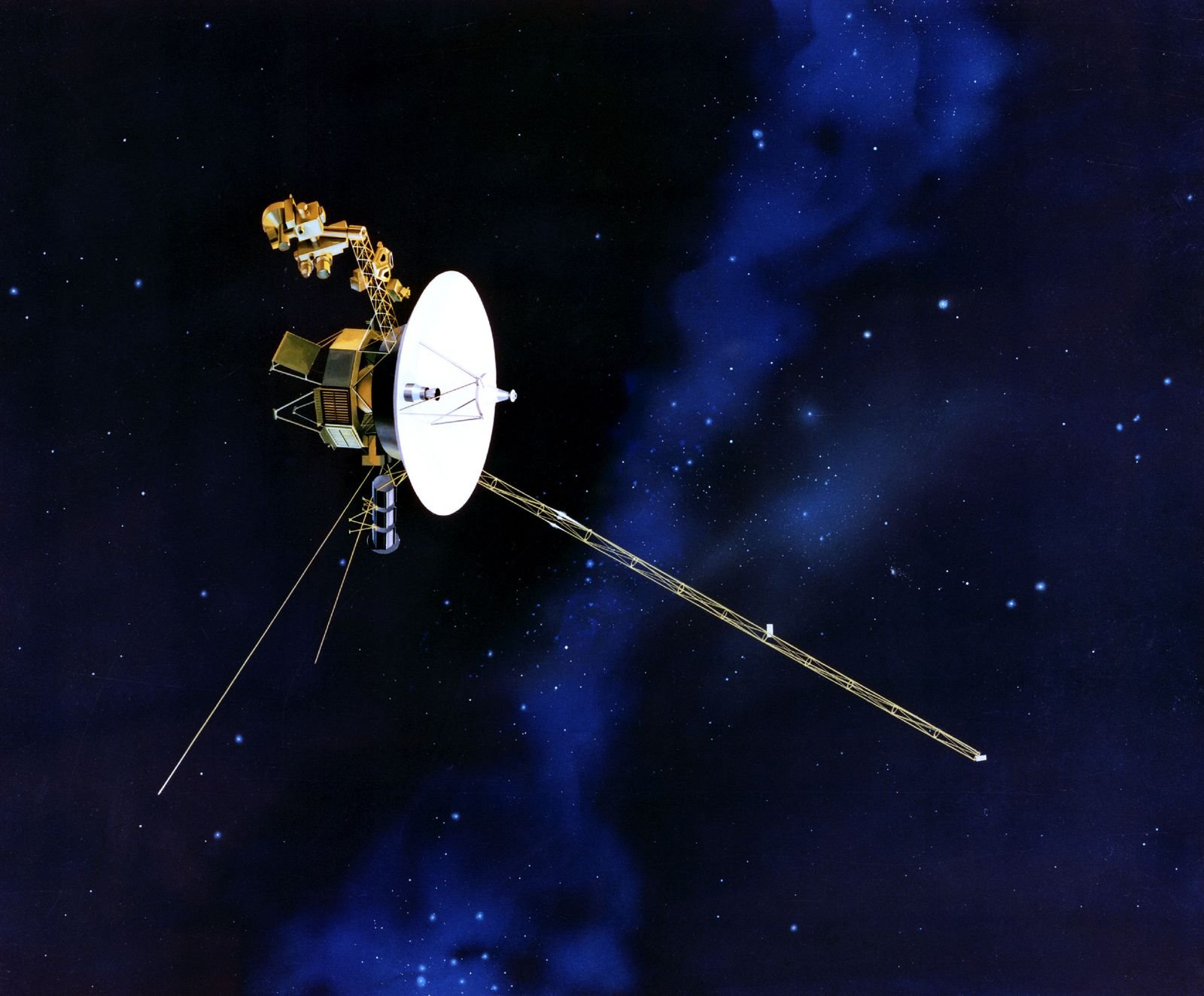
NASA's Voyager 1 spacecraft is about to cross a line no human-made object has ever reached. On Wednesday, November 18, the 49-year-old probe will become the first machine ever to travel one full light-day from Earth — so far away that a radio signal takes an entire day to reach it, and another day to come back.
NASA announced the milestone on Tuesday. The space agency puts the crossing at 05:16:07 Eastern Time on November 18, when Voyager 1 will be 16,094,799,096 miles — 25,902,068,356 kilometers — from Earth. At that distance, a command sent from California on Wednesday morning arrives on Thursday, and the reply turns up on Friday.
Voyager 1 launched from Cape Canaveral on September 5, 1977, two weeks after its twin, Voyager 2, on what was meant to be a four-year tour of Jupiter and Saturn. Nearly half a century later it is still traveling at about 38,000 miles per hour (61,000 kilometers per hour) and is the most distant human-made object from Earth. It will mark the 50th anniversary of its launch next year.
To mark the occasion, NASA is inviting people around the world to take part in "Shine Bright for Voyager's Light-Day." Participants are asked to flash the mission's three-letter designation — VGR — in Morse code after sunset on November 17, using a flashlight or NASA's website, creating what the agency calls "a symbolic wave of golden light encircling the planet after sunset." Not that Voyager 1 will be able to see it: its cameras were turned off decades ago, after the famous Pale Blue Dot image was captured in February 1990.
The probe's longevity is a testament to the engineers who built and still operate it, but the margins are now thin. Voyager 1 suffered a brief communications interruption in October, losing contact for about 48 hours before the team at NASA's Jet Propulsion Laboratory restored the link. Only a few of its instruments are still running, and its dwindling power supply is carefully rationed.
Its twin is far behind. Voyager 2, which took a different path through the solar system to swing past Uranus and Neptune, is not expected to reach the one-light-day mark until November 2035 — and it is uncertain whether it will still be able to communicate by then, even with recent efforts to stretch its dwindling power supply. NASA's Jet Propulsion Laboratory is scheduled to host a discussion on November 19 featuring members of the Voyager mission team and NASA leadership.