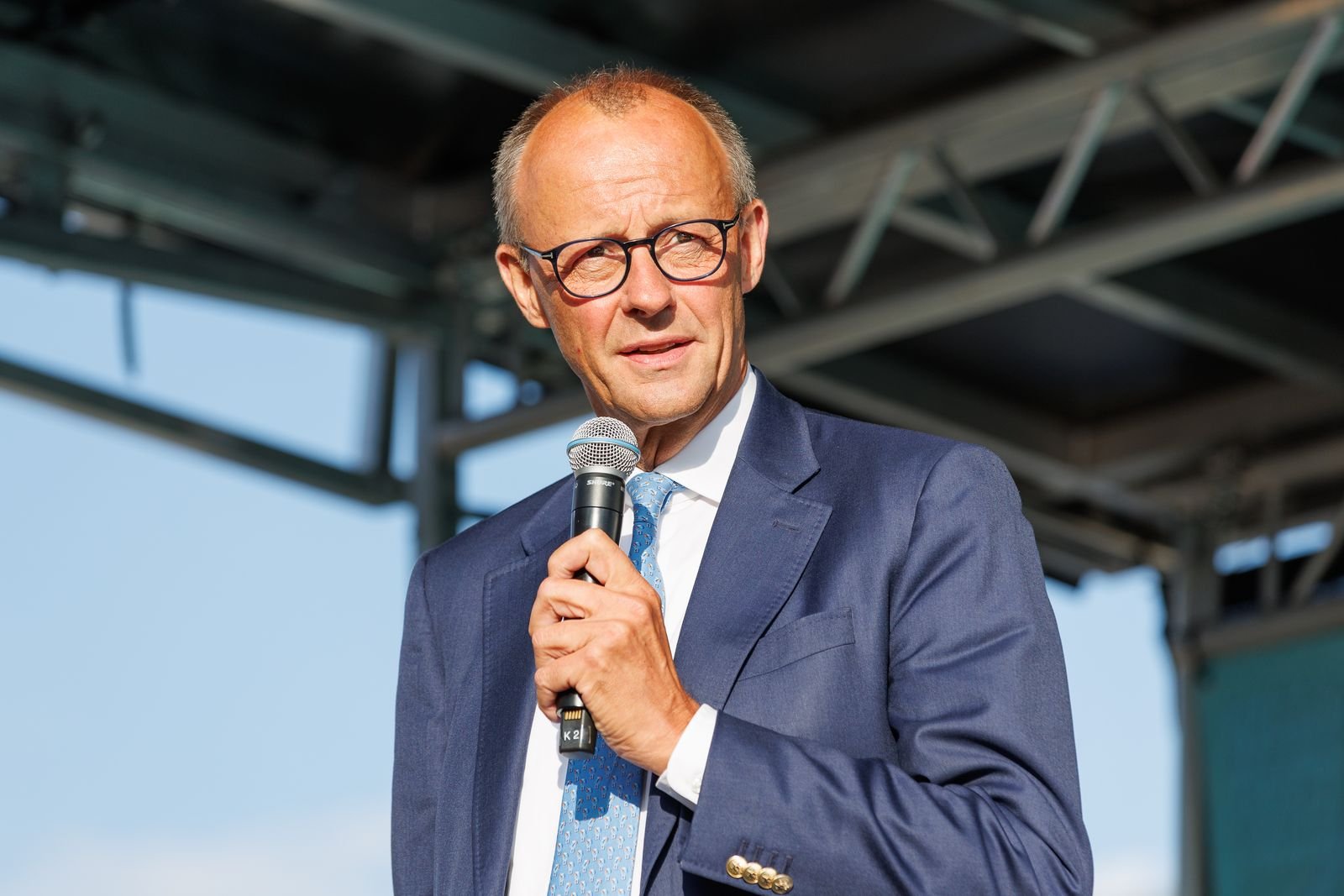
DUBLIN — Slovenia and Ireland have joined the revolt against German Chancellor Friedrich Merz’s demand to embed Ukraine funding in the European Union’s next seven-year budget, leaving the chancellor short of allies two weeks before EU leaders meet to settle the issue.
Merz has threatened to withhold Germany’s support for the 2028-2034 Multiannual Financial Framework, the bloc’s long-term budget, unless all 27 member states help raise fresh EU-backed loans for Ukraine from 2028 onwards. Ukraine is requesting another €45 billion for next year, and the European Council could decide by the end of the year to grant a new support loan of around €43 billion.
Four countries — Bulgaria, Hungary, the Czech Republic and Slovakia — had already refused to take part in any future loan. Slovenia and Ireland have now joined them, and the opposition spans six capitals, according to a count by the Brussels news portal Rapporteur. Because the budget requires unanimous approval from all 27 member states, each opposing capital holds a veto.
Janez Janša, the Slovenian prime minister and a vocal ally of Ukrainian President Volodymyr Zelenskyy, questioned on Friday whether using the budget as a threat was the right strategy. “We are not in favour of this linkage, because the negotiations on the EU’s next seven-year financial framework are already quite complicated and demanding,” he said.
Micheál Martin, the Irish prime minister hosting the informal leaders’ meeting in Dublin, said that while he understood the move, he had “some concerns” with it. Ireland, which holds the rotating presidency of the Council of the European Union, wants to close a deal on the budget by the end of its time at the helm in Brussels.
The pushback from the original four has been blunt. Czech Prime Minister Andrej Babiš said: “I am completely against, because the European budget is about European countries and the help for Ukraine we have to discuss it separately.” Hungarian Prime Minister Péter Magyar, who met Merz in Berlin last week, argued that the EU budget was not the appropriate instrument for financing Ukraine, pointing out that his country had delivered aid to Ukraine and taken in refugees. Slovak Prime Minister Robert Fico accused Merz of “blackmail” for tying Ukraine aid to the budget talks and said he could also veto the next long-term budget. Bulgarian Prime Minister Rumen Radev took a softer stance in Dublin, saying: “We are prepared to discuss mechanisms to ensure that these funds are used not for weapons, but for humanitarian activities.”
France also did not consider it appropriate to establish such a link, and Finland has argued that Ukraine’s funding needs must not be taken hostage in the budget dispute.
In a letter sent to the EU leadership last week, Merz argued it was unfair for the four countries to demand Germany’s support for cohesion funding in the next budget while refusing to share the financial burden Berlin is carrying for Ukraine. Germany is both the largest contributor to the EU budget and the largest financial supporter of Ukraine.
Other capitals have rallied around Merz. “I believe that solidarity is indeed not a one-way street,” Austrian Chancellor Christian Stocker said, suggesting that the agreement that allowed Hungary, the Czech Republic and Slovakia to opt out of a €90 billion EU loan for Ukraine in 2025 was a one-off. Sweden’s Ulf Kristersson, Latvia’s Andris Kulbergs, Estonia’s Kristen Michal and Luxembourg’s Luc Frieden also backed the German push. Among the countries that receive more from the EU budget than they contribute, only Estonia and Latvia back Merz; among net payer states, he has so far secured support only from Austria, Sweden and Luxembourg.
EU leaders are due to meet at a special European Council summit on November 26-27 dedicated to the long-term budget and Ukraine funding, where the dispute over whether Ukraine funding belongs inside or outside the budget is likely to dominate talks.