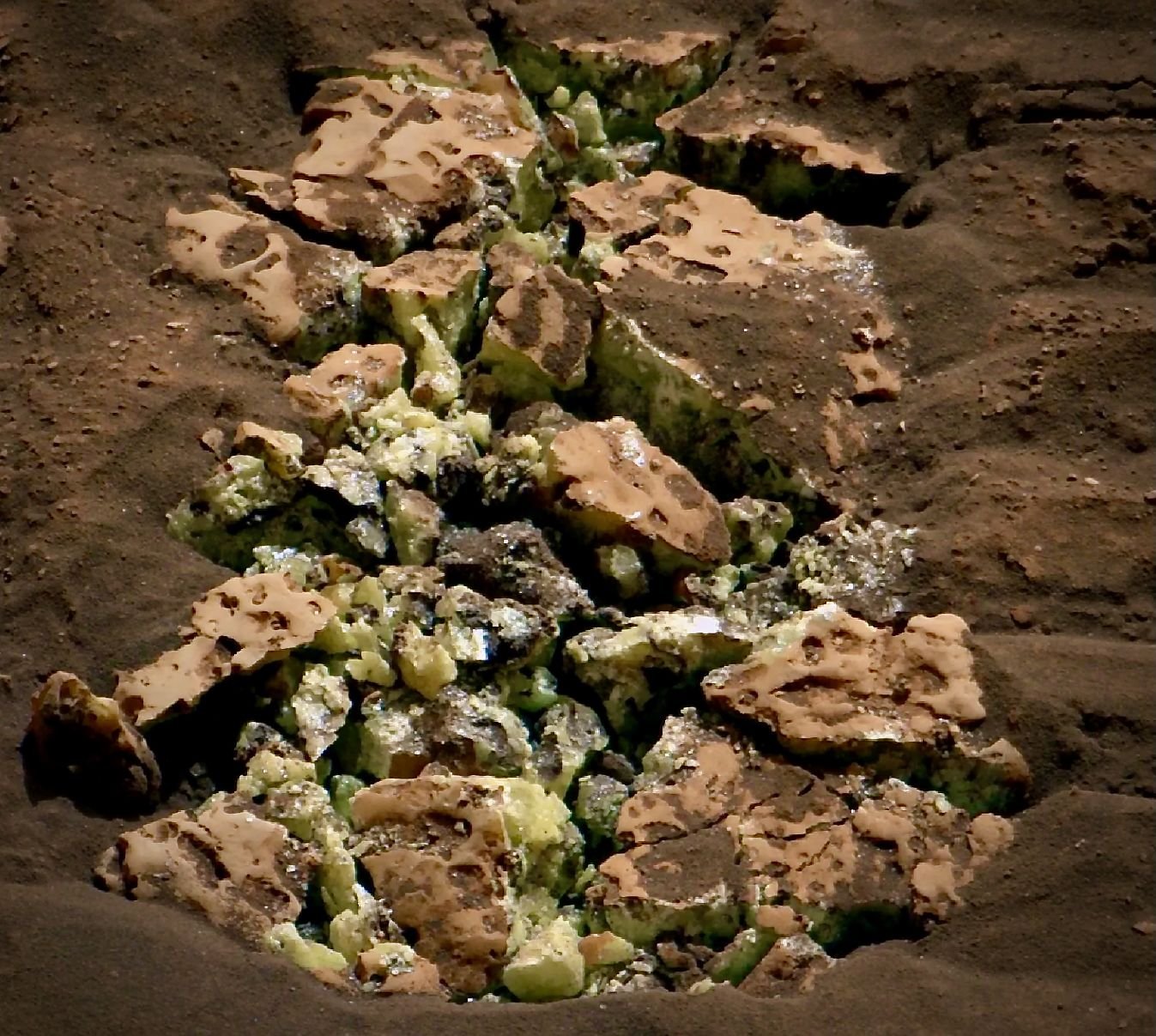
In 2024, NASA's Curiosity rover rolled its 899-kilogram body over a completely unremarkable rock in the Gale Crater's Gediz Vallis Channel — and the rock burst open under the strain, revealing pale yellow crystals of startlingly pure elemental sulfur inside.
Although sulfate minerals are fairly common on Mars, the find marked the first time sulfur had been found on the red planet in its pure elemental form. And the discovery turned out to be far bigger than a single rock: the sulfur lay scattered across an area measuring some 2,100 square meters, with the surrounding ground littered with more of the same kind of stone.
"Finding a field of stones made of pure sulfur is like finding an oasis in the desert," Curiosity project scientist Ashwin Vasavada of NASA's Jet Propulsion Laboratory said at the time.
Now two new studies have begun to piece together how the strange deposit might have formed — and what it could tell us about the ancient Martian environment. In a paper published in the journal Science in June 2026, a team led by planetary scientist Scott VanBommel of Washington University in St. Louis took a closer look at Curiosity's images and chemical measurements of the sulfur-rich rocks. The team confirmed the sulfur was remarkably pure, a stark contrast to the sulfate minerals usually found on Mars, and estimated the deposit formed between 3.1 and 2.8 billion years ago.
VanBommel and his colleagues, including co-leader Jeff Berger of NASA's Johnson Space Center, believe the most plausible explanation is that the sulfur originated in gases released by ancient volcanic activity. As those gases cooled, they became trapped beneath the Martian surface, possibly within cage-like structures of ice called clathrates. Over time, erosion carved out Gediz Vallis, releasing pressure on the buried gases and allowing them to escape, and chemical reactions between the sulfur-bearing gases could then have produced deposits of pure sulfur without the need for high temperatures at the site.
A separate study published in Geophysical Research Letters in July 2026 tested another route. Atmospheric scientist Jiawei Wang of Cornell University and his team mixed dissolved sulfide with chlorate, a compound containing chlorine and oxygen that may have been present on ancient Mars, in acidic water at room temperature — and the reaction produced tiny yellow crystals of elemental sulfur. Lower concentrations of chlorate favored the formation of pure sulfur, while higher concentrations produced more sulfate. The crystals were microscopic, rather than the chunks Curiosity encountered, but the researchers suggest similar reactions occurring over much longer periods could produce larger deposits — and the hydrogen sulfide needed for the reaction could have come from the same underground gas reservoirs proposed by VanBommel's team.
Crucially, neither study offers evidence of life on Mars. Sulfur is an essential element for all life — many organisms take it up in the form of sulfates to make two of the amino acids essential for building proteins — and although microbes can produce elemental sulfur here on Earth, Wang's experiments show living organisms are not necessary to explain how it might have formed on Mars. "Mars provides us with a frozen snapshot from billions of years ago," Berger said. "We can go back and look at deep time in a way that we can't do on Earth."