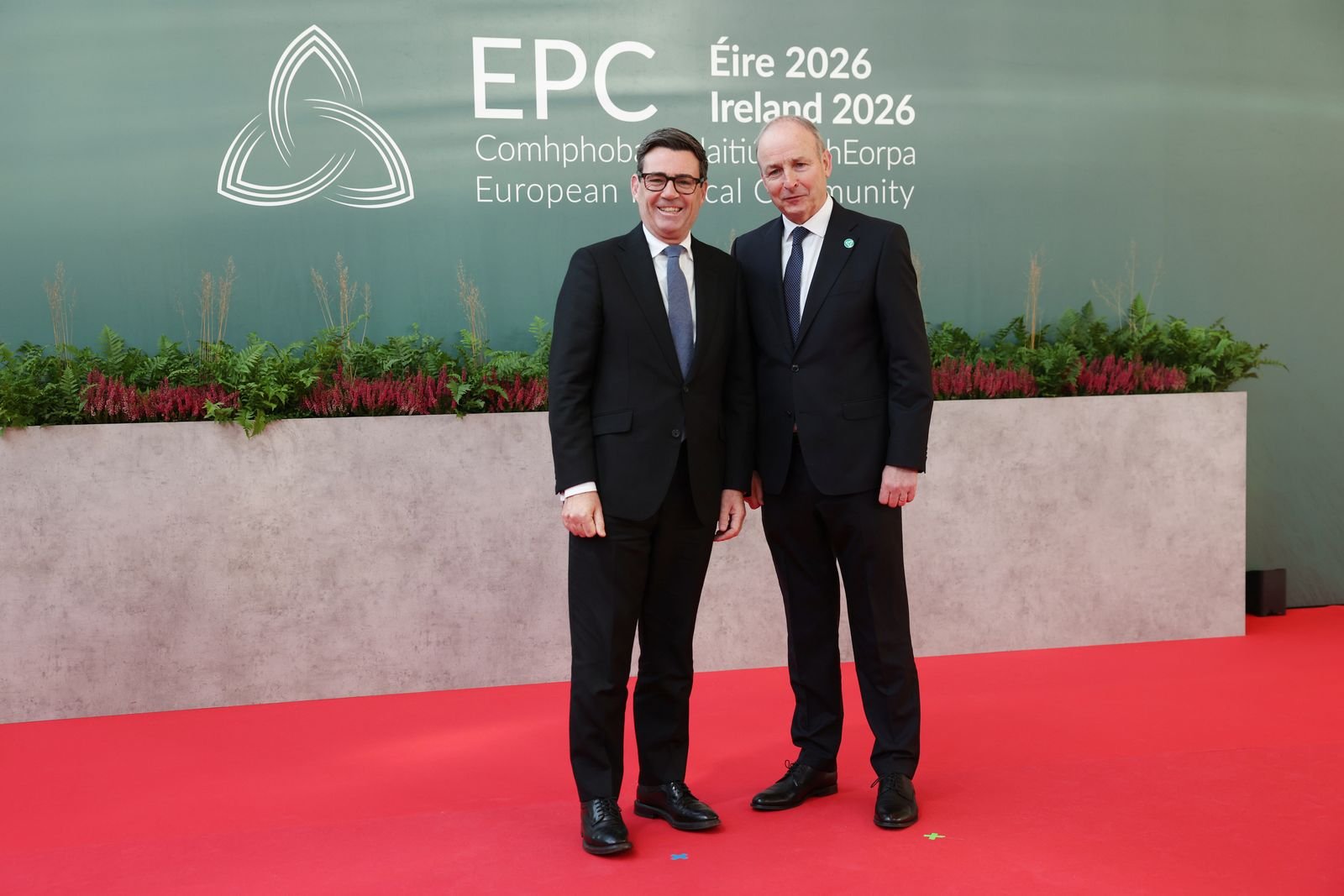
DUBLIN — Forty-one European leaders have endorsed a joint declaration pledging tougher border controls and more effective returns of people with no legal right to remain in Europe, in one of the main outcomes of this week's summit in Dublin.
The joint leaders' statement on migration, issued at the European Political Community summit on November 12 and published on Friday, was initiated by British Prime Minister Andy Burnham, Danish Prime Minister Mette Frederiksen and Italian Prime Minister Giorgia Meloni. Its endorsers include leaders from EU and non-EU states, European Commission President Ursula von der Leyen and Council of Europe Secretary General Alain Berset.
The leaders committed to a “whole-of-route” approach to irregular migration, from countries of origin and transit to Europe's external borders. Their priorities include early-warning systems to predict and manage flows, tackling disinformation about illegal crossings, sharing information more systematically across borders, and strengthening cooperation with countries of origin and transit so that people without a right to stay can be returned effectively and in accordance with international law.
The declaration also recognises the use of migration as an instrument of hybrid warfare, an issue that has grown in importance following migration pressure orchestrated by Belarus along the borders of Poland and Lithuania, and stresses the role of international conventions — 75 years after the adoption of the Refugee Convention — as a cornerstone of protection.
The agreement does not abolish the right to asylum or restrict legal immigration, and the Dublin declaration is a political commitment rather than a new European law. Notably, it contains no explicit commitment to the return hubs in third countries that the EU Council authorised member states to establish in rules adopted on October 1, showing governments have not yet agreed on every part of the emerging policy.
The policy shift comes even as irregular arrivals fall. Frontex figures published on November 13 recorded almost 110,000 irregular border crossings during the first ten months of 2026, a fall of 29 per cent compared with the same period last year.
The leaders agreed to keep momentum toward a sustained reduction in numbers and to discuss the issue again at the next European Political Community summit in Switzerland.
The migration declaration was one of the main outcomes of the Dublin gathering, where nearly 50 leaders met on Thursday and Friday. The summit's other headline result was agreement that Europe — represented by France, Germany, Italy, the UK and Poland, alongside EU institutions — will take part in future Ukraine peace talks.