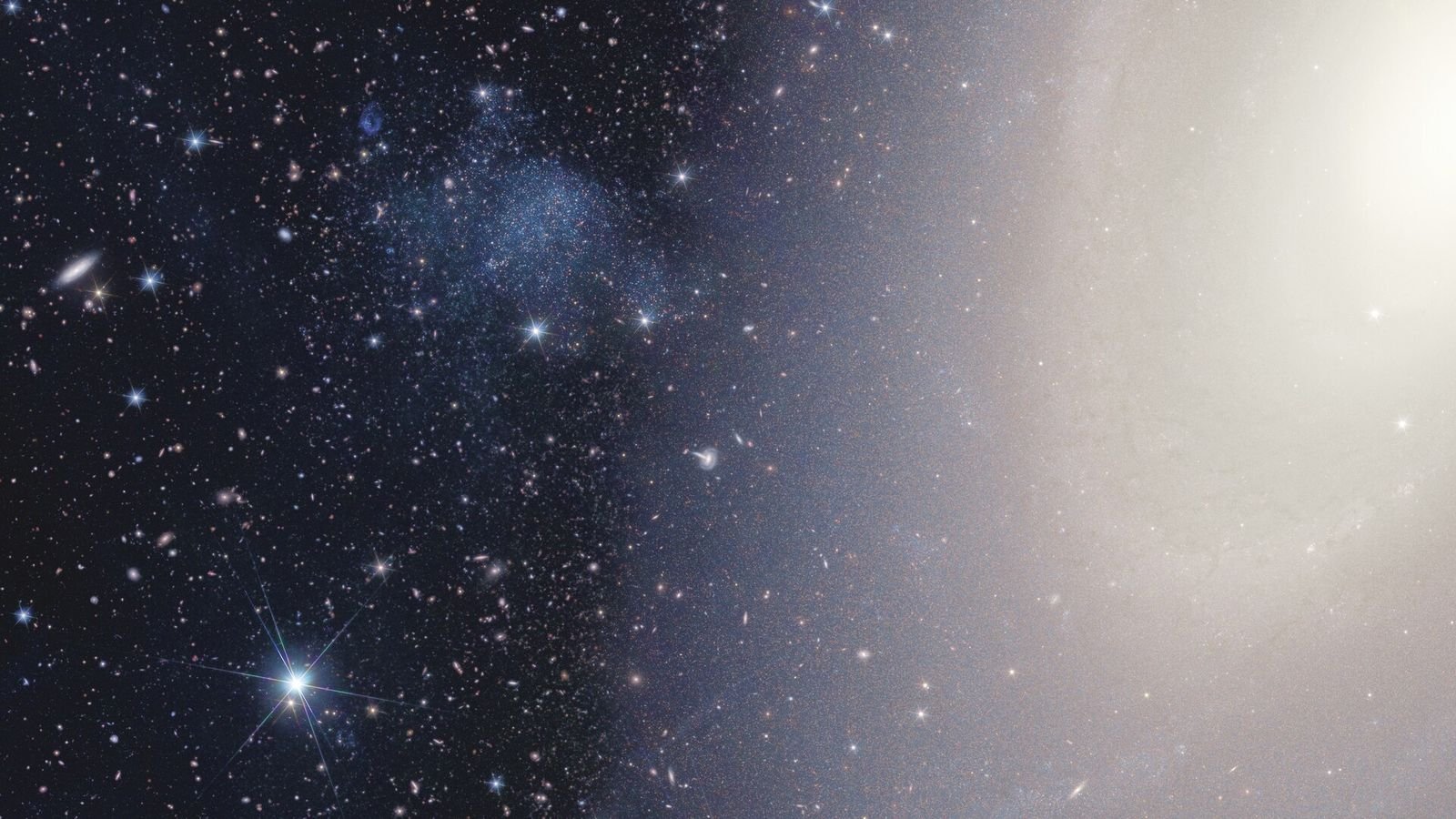
The European Space Agency's Euclid mission has released its first major batch of data, capturing the light of more than a billion objects and laying the foundation for its largest-ever three-dimensional map of the cosmos.
The release, named DR1-Foundation, was published on Thursday, November 12. It comprises around 13 months of observations gathered from spring 2024 to spring 2025, and marks the first major release of mission data since the space telescope launched in mid-2023.
The Euclid Wide Survey in the release covers 1,900 square degrees of sky — an area as big as about 9,500 full moons, or around 14 per cent of the area the six-year mission plans to survey. Previous releases covered only about 60 square degrees from a few days of observations.
In total, the release catalogues more than a billion objects, including more than 900 million galaxies and more than 60 million quasar candidates, along with spectra for more than 160 million sources. It holds more than 120,000 calibrated image frames from the telescope's visible-light camera and near-infrared spectrometer and photometer, and identifies 15,072 high-confidence strong gravitational lens candidates.
The data volume reaches about 1.7 million gigabytes — 1.7 petabytes — including a sky mosaic measuring 500 gigapixels. ESA's director of science, Carole Mundell, called it the "largest space-based survey of its kind, laying the foundation of future discovery in a new regime for astronomy."
The release includes striking images of the Messier 81 galaxy group, the ring galaxy NGC 1291, about 33 million light-years away, and the Abell 3128 cluster of hundreds of galaxies, about 800 million light-years away.
Euclid launched on July 1, 2023, and began routine science observations on February 14, 2024, from the L2 Lagrange point, 1.5 million kilometres from Earth. Its mission is to map the large-scale structure of the universe to probe the nature of dark matter and dark energy.
The release is a foundation, not a finished map: it provides observations, calibrated images, catalogues and spectra, while the higher-level cosmology measurements — including weak-lensing analysis and calculations of how galaxies and clusters fit into the cosmic web — are postponed to the full Data Release 1, due in mid-2027.
The data is public and can be explored through ESA's Euclid Data Space platform.