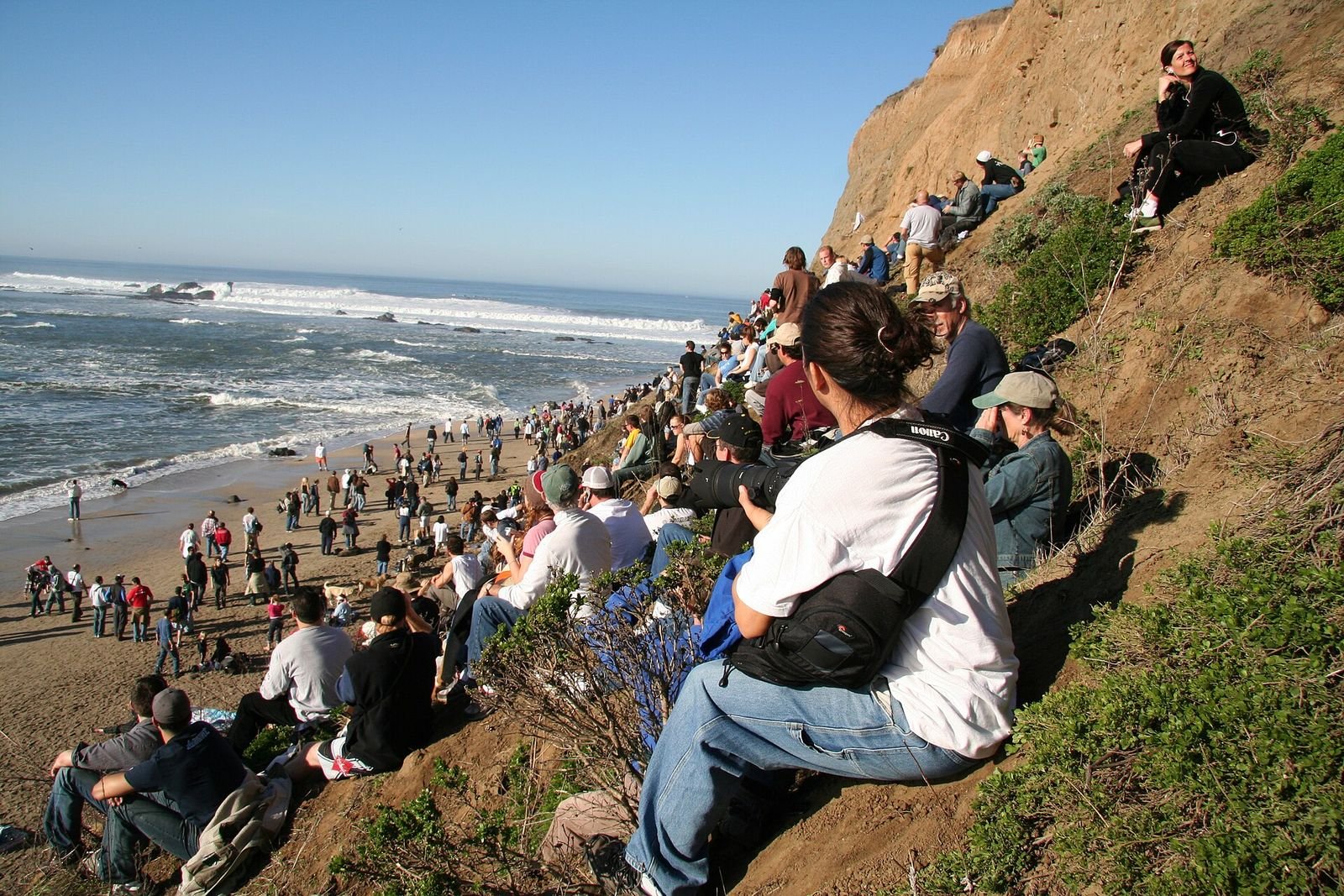
The biggest waves in more than a decade pounded the California coast on Saturday, the San Francisco Chronicle reported, with the intense surf crashing onto beaches and raising the threat of flooding to coastal roads and communities.
High surf and coastal flood warnings and advisories were in effect along the coast as the National Weather Service advised people to stay out of the water and not even get near it. “No selfie of the crashing waves is worth losing your life,” said Roger Gass, a meteorologist at the Weather Service office in Monterey, California.
The tumultuous surf arrived with a powerful swell generated by intense winds thousands of miles off the coast that traveled across the Pacific, building energy along the way. The waves grew in size Friday night, as a rainstorm swept the state. They grew even larger Saturday morning, smashing into coastal piers and sending water farther up beaches than usual.
The biggest waves were expected in Northern California, with heights of more than 40 feet at fully exposed beaches and reaching more than 50 feet at Mavericks, the big-wave surf spot 20 miles south of San Francisco. Mark Sponsler, who runs the website Stormsurf, estimated that waves at the site were more than 50 feet, potentially nearing 60 feet, on Saturday morning. National Weather Service Bay Area meteorologist Rachel Kennedy said localized waves at Mavericks reached 50 to 60 feet.
An offshore buoy near Point Reyes recorded a significant wave height of 31 feet at 9 a.m. Saturday, according to data cited by the San Francisco Chronicle — the second-largest reading in three decades of records at the station, trailing only a December 2015 storm. The Scripps Institution of Oceanography said forecast wave heights of that magnitude in November were virtually unprecedented in the buoy's 27-year history.
In Pacifica, towering waves repeatedly crashed over the seawall and surged into city streets, flooding streets and endangering homes. The city's shoreline was among the hardest hit as the swell pushed ocean water inland toward homes and businesses.
In Santa Cruz, about 90 minutes south of San Francisco, city beaches were closed through Sunday and around 270 homes in Santa Cruz County were under evacuation warnings. These are the biggest waves the region has seen since December 2024, when the surf tore apart the municipal wharf. On Saturday, the wharf was closed.
Jason Hoppin, a spokesman for the county, said that as of noon local time, there were a few road closures and no evacuation orders had been issued, though the threat of flooding remained. “We're seeing some minor flooding, but our infrastructure is holding up so far,” Mr. Hoppin said. He added that he walked the shore Saturday morning and did not see a single surfer at the Hook, a break that is often packed. “It's like seeing an empty downtown in a big city.”
While the intense swell brought conditions too dangerous for even seasoned surfers at most beaches, it generated the huge walls of water that big-wave surfers crave at Mavericks, the famous break a half mile offshore from Half Moon Bay. The big-wave surfer Bianca Valenti, 41, of San Francisco, was at Mavericks and said the waves were huge but that winds at the coast made them “very precarious and bouncy.” Ms. Valenti said she saw both “great rides” and “some crazy wipeouts” on Saturday morning.
The swell triggered the first coastwide High Surf Warning in California since December 2024, with the warning in effect through Sunday morning. Forecasters said another swell of near 20 feet was expected Sunday night into Monday, with rough seas and successive Pacific storms continuing through the week as a strengthening El Niño drives bigger waves and higher tides.