Massive Support Across Sectors for Pro-Growth Tax Reform
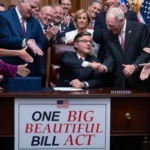
U.S. Manufacturers Hail Trump, President Trump’s One Big Beautiful Bill Act is earning glowing praise from manufacturing leaders. Signed on July 4, this sweeping legislation brings substantial changes to tax policy, reigniting optimism across America’s industrial sectors.
It includes provisions for 100% immediate expensing, research and development credits, and permanent deductions that fuel domestic manufacturing growth. While critics raise environmental concerns, industry stakeholders are united in calling the bill a bold step toward national economic revitalization.
Chemical and Electrical Industries Praise Long-Term Stability
Debra Phillips, CEO of the National Electrical Manufacturers Association (NEMA), called the bill essential for domestic energy resilience and innovation. She highlighted the permanent incentives for grid reliability and production capacity.
“NEMA strongly supports this legislation,” she stated. “It brings the certainty our sector needs to scale production and ensure national energy security.”
The American Chemistry Council also celebrated the move. CEO Chris Jahn called it “smart tax policy that delivers more certainty,” allowing manufacturers to expand, innovate, and compete globally.
Trump Delivers Big for the Steel Industry
Philip K. Bell, President of the Steel Manufacturers Association, declared the bill a “signature win” for American steelmakers.
“By renewing immediate expensing for capital equipment and R&D, this bill supercharges investment,” Bell said. “Steel manufacturing is at the core of every major infrastructure and defense effort. Now, we have a tax code that reflects that reality.”
He credited the bill for reducing costs and accelerating investments in steel towns nationwide. With America’s steelmakers competing against foreign-subsidized production, this bill provides a major competitive edge.
Semiconductor Manufacturing Sees Explosive Growth Potential
The Semiconductor Industry Association (SIA) praised the strengthened manufacturing investment credit. CEO John Neuffer stressed its role in tripling U.S. chip capacity by 2032 and supporting over 500,000 American jobs.
“This is a strategic investment in our future,” Neuffer said. “It reinforces the U.S. position in the global tech race and strengthens supply chains critical to national security.”
American Petroleum Institute Celebrates Energy Breakthrough
The energy sector is also riding a wave of enthusiasm. American Petroleum Institute (API) President Mike Sommers hailed the bill as the “most important energy law in a generation.”
“It unleashes investment and reaffirms American energy leadership,” Sommers said. The bill opens lease sales onshore and offshore and supports domestic production from Alaska to the Gulf of Mexico.
Equipment Manufacturers Gain Investment Clarity
Kip Eideberg, SVP of the Association of Equipment Manufacturers, emphasized that the bill delivers what their industry has long needed: consistency and clarity in tax policy.
“Pro-manufacturing tax provisions mean growth, jobs, and innovation,” he explained. “This law empowers equipment makers to build better and scale faster.”
Eideberg also commended the administration and Congress for their dedication to revitalizing U.S. manufacturing.
Auto Suppliers and Plastics Industry Applaud Stability
Motor & Equipment Manufacturers Association (MEMA) CEO Bill Long noted that vehicle suppliers — the largest manufacturing sector by jobs — would now benefit from a renewed and stable tax framework.
“The bill locks in essential provisions like the 20% passthrough deduction,” he stated. “This ensures competitiveness and keeps auto supply chains anchored in the U.S.”
Matt Seaholm, CEO of the Plastics Industry Association, echoed this optimism. “We advocated directly for many of the bill’s components,” he said. “It supports our $519 billion industry and over a million American workers.”
Environmental Critics Voice Strong Opposition
Not all feedback has been positive. The Electric Vehicles Association sharply criticized the bill for cutting clean energy provisions, rolling back fuel economy standards, and eliminating the Greenhouse Gas Reduction Fund.
They called the bill a “step backward” for environmental progress, warning of increased emissions and reduced innovation in clean technologies.
Environmental groups argue that while the bill strengthens industrial growth, it may do so at the expense of climate commitments. Advocates are urging Congress to consider separate legislation to restore green incentives.

Unified Industry Message: Invest in America
Despite pushback from environmental corners, the overarching message from manufacturers remains clear — the One Big Beautiful Bill is a game-changer.
Jay Timmons, President of the National Association of Manufacturers, summed it up: “This is what happens when leaders listen to the people who build America. This bill puts factories in motion, products on shelves, and workers in good-paying jobs.”
He emphasized that manufacturing is bipartisan and touches every state. Timmons continued, “It doesn’t matter if your state is red or blue. Manufacturing is about communities, families, and the future.”
R&D and Innovation Take Center Stage
The Society of Chemical Manufacturers reinforced the importance of research and development. VP Robert Helminiak stated, “Robust R&D credits are crucial to maintaining global leadership in specialty chemistry. This bill delivers exactly that.”
This sentiment is shared across sectors, from semiconductors to automotive. Investment in innovation is now more feasible and more attractive, giving America a decisive edge over foreign competition.
Conclusion: Manufacturing Renaissance Begins Now
The One Big Beautiful Bill Act may go down as one of the most consequential pro-manufacturing laws in modern American history. With robust tax reforms, permanent business incentives, and a renewed national focus on domestic production, industry leaders are confident in a new era of growth.
Manufacturers across steel, semiconductors, chemicals, energy, plastics, and more are poised to expand, hire, and lead. The U.S. is now better positioned to reclaim its place as the world’s industrial powerhouse.
The renaissance of American manufacturing is not on the horizon. It’s here.
For more latest news checkout our website: latestglobalinsight