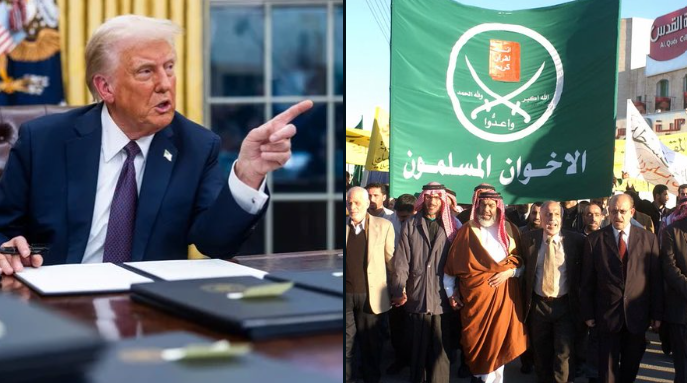
President Donald Trump announced Sunday that his administration is preparing to formally classify the Muslim Brotherhood as a foreign terrorist organization, a significant policy move aimed at a group long accused by critics of fostering extremism and destabilizing governments across the Middle East.
Trump told Just the News that the designation would be issued “in the strongest and most powerful terms,” noting that the paperwork is now being finalized. The decision follows new reporting on the organization’s global activities and renewed concern from senior officials within the administration. Trump has periodically explored this move since his first term in office.
Founded in Egypt in 1928, the Muslim Brotherhood grew into an international Islamist movement with political branches, affiliated parties, and ideological offshoots around the world. Supporters portray it as a social and political organization, while opponents argue it provides an intellectual foundation for extremist networks.
The President’s announcement comes on the heels of Texas Governor Greg Abbott’s declaration that he intends to classify both the Muslim Brotherhood and the Council on American-Islamic Relations (CAIR) as foreign terrorist and transnational criminal entities. Abbott sharply accused both groups of working to impose extremist interpretations of Islamic law and engaging in activities that undermine U.S. institutions.
Lawmakers from both parties have pushed the State Department to consider the designation, arguing that the Brotherhood’s global structure and influence warrant stronger U.S. action. Secretary of State Marco Rubio said in August that the process was underway but complicated, given the organization’s many regional variations and affiliated groups.
Across the Middle East, several governments have already taken forceful steps against the Muslim Brotherhood. Egypt labeled the group a terrorist organization in December 2013 after a deadly bombing in Mansoura. Saudi Arabia and the United Arab Emirates issued similar designations in 2014, with the UAE extending its list to include Al-Islah, a domestic Brotherhood-linked movement. Bahrain has also classified the Brotherhood as a terrorist entity.
Jordan moved earlier this year to formally prohibit all Brotherhood activities, ruling the organization illegal nationwide. Elsewhere, Russia banned the group in 2003, followed by Tajikistan and Kazakhstan in 2006. Libya’s Tobruk-based parliament designated the Brotherhood a terrorist organization in 2019, while Syria outlawed membership decades earlier, imposing severe penalties.
Western governments, including the United States, the United Kingdom, and the European Union, have historically stopped short of labeling the broader Muslim Brotherhood a terrorist organization, though some branches notably Hamas are designated differently.
In Washington, congressional efforts are now underway to revisit the U.S. position. Meanwhile, European leaders have launched their own reviews. French President Emmanuel Macron recently instructed his government to draft new policies aimed at curbing the influence of the Muslim Brotherhood and other forms of political Islamism.
If finalized, the U.S. designation would mark one of the most consequential foreign-policy steps of Trump’s current term and could significantly reshape American engagement with political groups and governments across the Middle East.