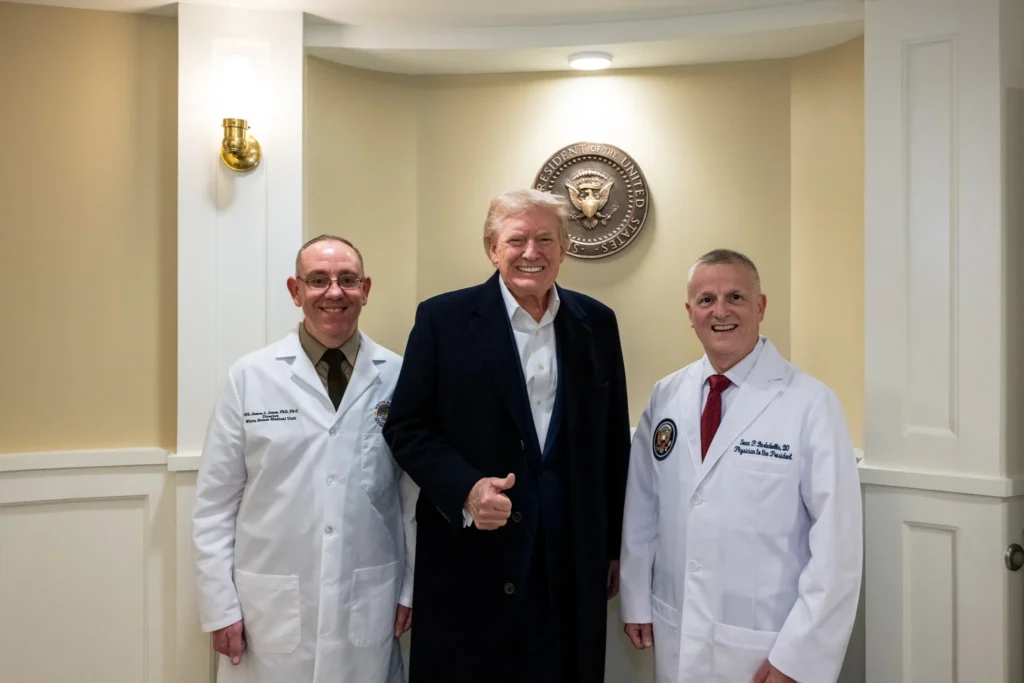
President Donald Trump confirmed that he underwent an MRI scan during his October visit to Walter Reed National Military Medical Center, a revelation that adds new context to a trip previously described by the White House as a routine medical checkup.
Trump disclosed the information while speaking with reporters aboard Air Force One, stating that the results of the MRI were “perfect” and “among the best” his doctors had ever observed. The president did not specify what part of the body was scanned or why the procedure had been performed, but emphasized that it confirmed his “excellent health.”
Routine Visit or Targeted Test?
At the time of Trump’s visit to Walter Reed, White House officials had publicly referred to it as a semiannual physical examination — a standard part of presidential health monitoring. The official summary released after the appointment included results from general tests and evaluations but did not mention an MRI or any related imaging procedure.
Medical experts note that magnetic resonance imaging (MRI) scans are typically used to diagnose or monitor specific medical conditions, rather than as part of standard health checkups. Routine physicals for individuals in their late seventies generally include blood work, cardiovascular assessments, and cognitive evaluations, but not advanced imaging unless clinically indicated.
The revelation that an MRI was performed has therefore raised questions about the motivation for the scan and whether there were any particular medical concerns being investigated at the time.
White House and Medical Context
The White House has not provided further clarification on why the MRI was ordered. No additional details have been released regarding symptoms, medical advice, or the scan’s focus area. Trump, who has long described himself as being in “excellent health,” has previously criticized what he calls “media speculation” about his fitness for office.
The president’s personal physician, whose annual summaries typically emphasize overall well-being and fitness, did not include the MRI in the October report. Historically, presidential health disclosures have varied widely — some administrations have shared detailed records, while others have limited information to general overviews.
Age and Transparency Concerns
At 79, Trump remains one of the oldest presidents in U.S. history, placing his health under particular public scrutiny. While undergoing an MRI at that age is not unusual, the lack of prior disclosure about the procedure has reignited debate about transparency surrounding presidential medical information.
Health policy observers note that questions about the extent of disclosure have long surrounded U.S. presidents, from Franklin D. Roosevelt’s paralysis to John F. Kennedy’s undisclosed health issues and more recently, instances involving Presidents Reagan and Biden. Each case has underscored the delicate balance between a leader’s right to medical privacy and the public’s right to be informed about their ability to govern.
Trump’s Response
Trump appeared dismissive of any suggestion that the MRI indicated health concerns, insisting that it was simply part of a thorough examination. “It was a perfect scan — the best they’ve seen,” he said, adding that his doctors were “extremely pleased” with the outcome.
He also suggested that the test demonstrated his continuing fitness for the presidency, describing himself as “in tremendous shape.”
Broader Implications
The revelation adds to a growing list of ambiguities surrounding presidential health disclosures, particularly when visits to medical facilities are labeled “routine” but later revealed to include additional procedures. Analysts suggest that while Trump’s MRI may have been precautionary, the omission of such details from official records can fuel speculation and erode public trust.
For now, the White House has not announced any plans to release updated medical information or additional context about the MRI. Trump, meanwhile, continues to frame the test as evidence of his vitality, using it to reinforce his image as a healthy and energetic leader heading into the next election cycle.