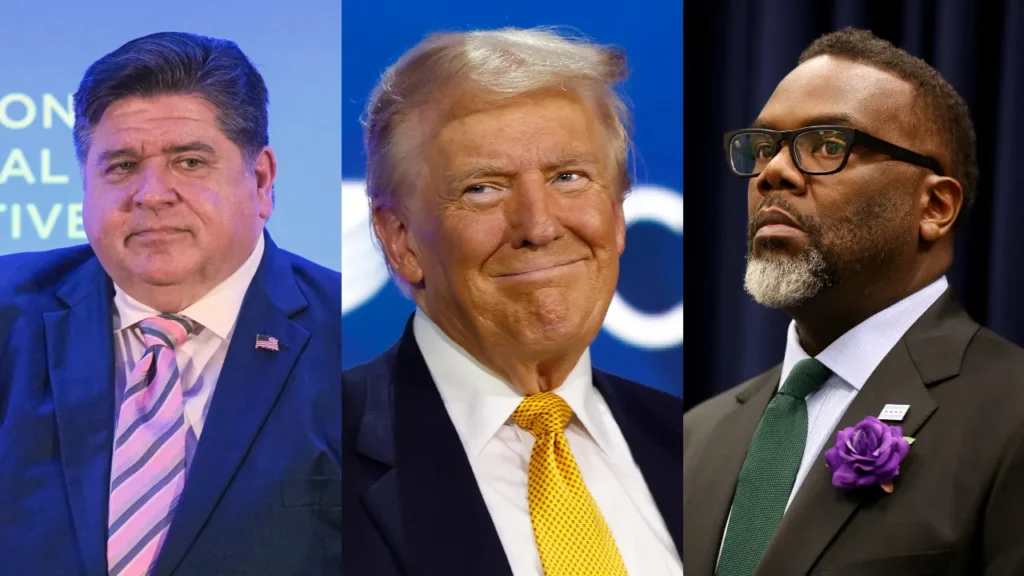
CHICAGO, Oct. 8 — President Donald Trump ignited a new political storm Wednesday by calling for the imprisonment of Chicago Mayor Brandon Johnson and Illinois Governor JB Pritzker, both Democrats, as his administration prepared to send National Guard troops into Chicago. The latest clash underscores the deepening rift between the White House and Democratic-led cities over federal intervention in local law enforcement and immigration policy.
Trump’s call came just hours after reports confirmed that hundreds of Texas National Guard members were stationed at an Army Reserve base outside Chicago, awaiting possible deployment. The move, ordered under Trump’s new directive to “restore law and order in America’s cities,” has faced resistance from state and local officials who accuse the president of abusing federal power for political gain.
On his social media platform, Trump accused both Johnson and Pritzker of failing to protect federal immigration officers working in the city. “Chicago Mayor should be in jail for failing to protect ICE officers! Governor Pritzker also!” Trump posted Wednesday morning, referring to agents from U.S. Immigration and Customs Enforcement.
The president’s remarks came as tensions escalate between the federal government and several Democratic governors who have publicly denounced the deployment of out-of-state troops without local consent. Governor Pritzker filed an emergency lawsuit earlier this week challenging the legality of the deployment, calling it a “blatant violation of state sovereignty.”
Mayor Brandon Johnson echoed those concerns, warning that Trump’s actions were “reckless and authoritarian.” Johnson insisted that Chicago’s law enforcement was capable of maintaining order without federal troops, adding that “the city will not be turned into a stage for political theater.”
Despite their opposition, Trump remains defiant. In remarks from the White House, he reiterated that federal intervention is necessary to combat “chaos and crime” in major cities. “We can’t let radical left politicians stand in the way of keeping America safe,” he said.
The president’s comments coincided with the ongoing legal troubles of former FBI Director James Comey, who is set to appear in court this week on charges many legal analysts have criticized as politically motivated. Trump has long targeted Comey, whom he fired in 2017, and now points to his prosecution as proof that “justice is finally being served.”
Critics argue that Trump’s pattern of demanding imprisonment for political rivals — a refrain dating back to his 2016 campaign — represents an erosion of democratic norms. Legal experts warn that such rhetoric, paired with the use of military forces in domestic affairs, could set a dangerous precedent.
Civil rights organizations swiftly condemned the president’s remarks, calling them “an assault on constitutional boundaries.” The American Civil Liberties Union (ACLU) said in a statement that Trump’s threats “reek of authoritarianism” and vowed to fight any unlawful deployment of federal forces.
At the same time, Trump’s supporters have applauded his tough stance, praising him for taking decisive action where, they say, local leaders have failed. Conservative commentators argue that Chicago’s persistent violence and immigration challenges justify federal involvement.
Inside Illinois, the mood remains tense. State lawmakers are divided, with Republicans urging cooperation with federal authorities and Democrats vowing to defend state autonomy. Some residents have expressed fear that the situation could escalate if troops enter the city.
As of Wednesday afternoon, National Guard vehicles and equipment remained stationed in Elwood, Illinois, just south of Chicago. Military sources said the deployment could move into the city “within days,” depending on final authorization from the White House.
The standoff between Trump and Illinois officials now threatens to become a constitutional confrontation testing the limits of federal power over state governance. With political temperatures rising and court challenges looming, Chicago could soon become the latest flashpoint in the administration’s broader crackdown on dissenting Democratic cities.