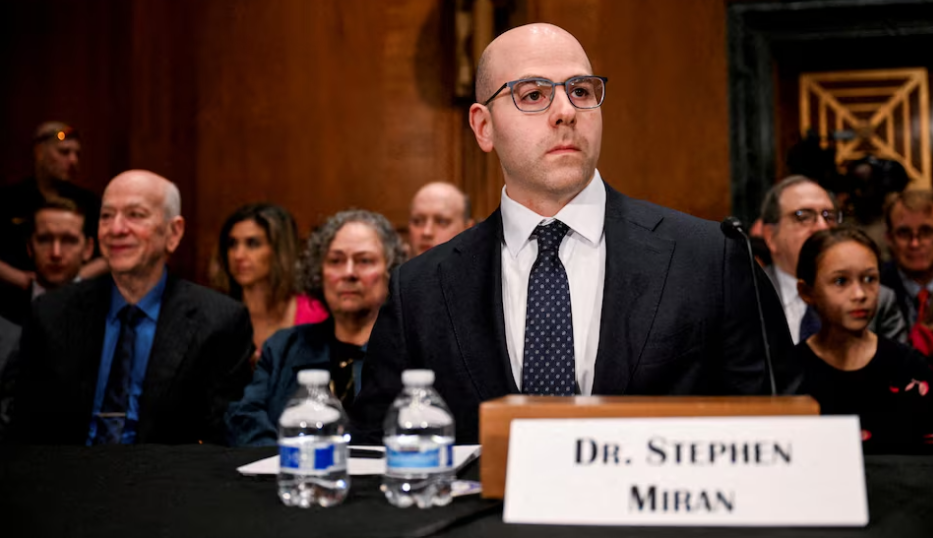
The U.S. Senate on Monday confirmed Stephen Miran to the Federal Reserve’s Board of Governors, giving President Donald Trump greater influence over the central bank just as officials prepare for a crucial interest rate decision. The vote was razor-thin at 48–47, breaking largely along party lines, with Alaska Republican Lisa Murkowski joining Democrats in opposition. The confirmation was unusually quick, taking less than six weeks after the surprise resignation of Fed Governor Adriana Kugler in August.
Miran, who serves as Trump’s top economic adviser as chair of the White House Council of Economic Advisers, will now hold one of 12 votes on interest-rate policy. He is expected to take part in the Fed’s two-day meeting starting Tuesday, where policymakers are widely projected to approve a quarter-point cut to support a cooling labor market. Analysts believe Miran may push for a deeper cut than most of his colleagues but not the multi-point reduction Trump has openly demanded.
While at the Fed, Miran’s responsibilities will go well beyond voting on rates, including work on committees that oversee financial regulation, community banking, and the budgeting of the Fed and its 12 regional banks. He will step aside from his White House role on unpaid leave during his Fed term, which officially runs until January 31, but he could remain in the position longer if a successor has not been nominated and confirmed. Democrats argue the arrangement makes him beholden to Trump, though Miran has rejected those claims.
Miran has been a defender of Trump’s economic agenda, maintaining that tariffs on imports will not drive inflation higher and that other administration policies, such as stricter immigration enforcement, could ease price pressures by reducing demand for housing. His confirmation adds another Trump-aligned voice to the Fed board, alongside Michelle Bowman and Christopher Waller, who both dissented at the July meeting in favor of looser monetary policy. With recent data showing more weakness in the labor market, analysts say another dissent is possible this week, raising the prospect of a rare three-way split among Fed governors — something not seen since the early years of Alan Greenspan’s chairmanship in 1988.