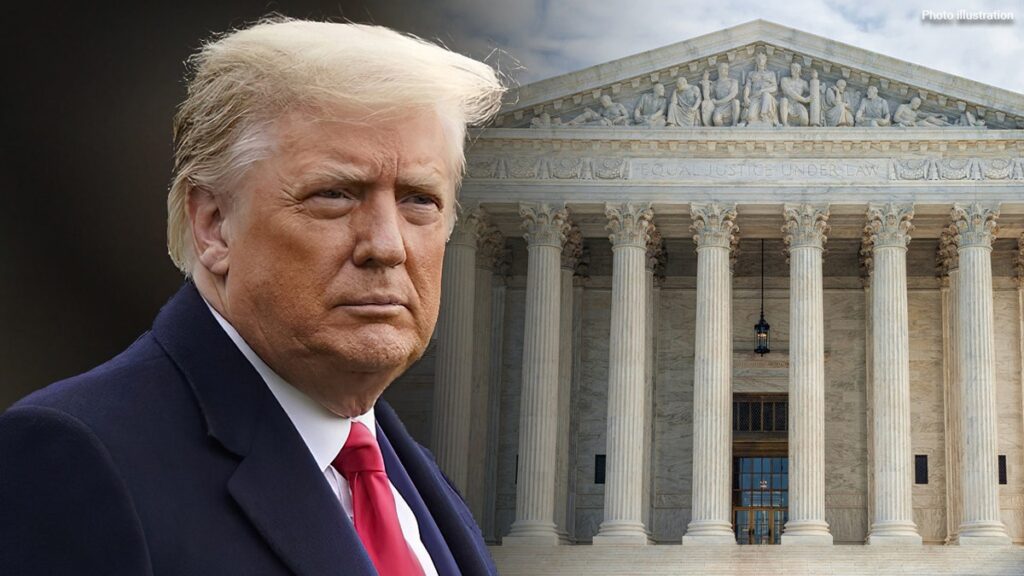
The Supreme Court heard arguments on Wednesday in a case that could have sweeping consequences for the U.S. economy, consumers, and the limits of presidential authority. At issue is whether former President Donald Trump exceeded his legal powers when he used an emergency law to impose tariffs on imports from more than 100 countries.
Trump’s team relied on the International Emergency Economic Powers Act (IEEPA) of 1977, a law that allows presidents to regulate financial transactions during national emergencies. His administration argued that America’s growing trade deficit and reliance on foreign goods posed an “extraordinary threat” to the nation’s economic stability—justifying broad tariffs to protect domestic manufacturing.
The move triggered intense backlash from both state governments and the business community. A coalition of twelve states and several small companies sued, claiming the tariffs were unconstitutional because Congress, not the president, holds the power to set taxes and duties on imports. They say Trump effectively bypassed Congress and used emergency powers in a way the law was never meant to allow.
Federal courts have so far split on the issue. Some lower judges ruled that the president overstepped by stretching a 1970s-era law beyond its original intent, while others concluded the statute’s language gives the executive broad discretion during emergencies. That uncertainty is now in the hands of the nation’s highest court.
The stakes could not be higher. Trump’s tariffs have generated hundreds of billions of dollars in revenue and reshaped global supply chains. If the Supreme Court strikes down the legal foundation of those tariffs, it could open the door to refund claims and major disruptions across industries—from steel and electronics to agriculture and consumer goods.
Supporters of the tariffs say they helped revive U.S. manufacturing, created new factory jobs, and gave Washington leverage in trade negotiations. They argue that presidents need flexibility to act swiftly when foreign economic pressures threaten national interests, especially when Congress moves slowly or remains divided.
But critics call that justification dangerous. They warn that letting presidents use “emergency powers” to rewrite trade policy undermines the separation of powers and could set a precedent for future leaders to unilaterally impose sweeping economic measures—without congressional approval or public debate.
The major questions doctrine, a key legal principle, looms large in the case. Under that doctrine, the Supreme Court has ruled in recent years that when an executive action carries vast economic or political significance, it must rest on a clear and specific grant of authority from Congress. The plaintiffs argue that no such clear authorization exists for tariffs under IEEPA.
From a business perspective, the outcome will shape how companies plan for the future. Many firms have adjusted supply chains, moved production, or absorbed higher costs since the tariffs began. Consumer advocates warn that keeping the tariffs could mean higher prices for imported goods ranging from clothing to electronics—essentially a hidden tax on households.
The Biden administration has quietly watched the case with concern. Although President Biden rolled back some of Trump’s trade policies, his administration has also used tariffs strategically—raising questions about how a ruling against Trump could limit future presidents from using similar tools in economic or geopolitical crises.
During oral arguments, the justices appeared divided. Some expressed skepticism about granting the executive branch nearly unlimited economic powers during vaguely defined “emergencies.” Others noted that Congress has historically given presidents wide latitude on national security matters and might not want the Court to narrow that authority.
Whatever the outcome, the decision will likely redefine how much control the White House has over international trade and emergency powers. A ruling in Trump’s favor would strengthen presidential authority across a range of economic issues. A ruling against him could return significant power to Congress and curtail decades of executive expansion.
The Court’s decision, expected next year, will not only determine the fate of Trump’s tariffs but also set the boundaries for how far future presidents can go in reshaping global commerce—on their own.