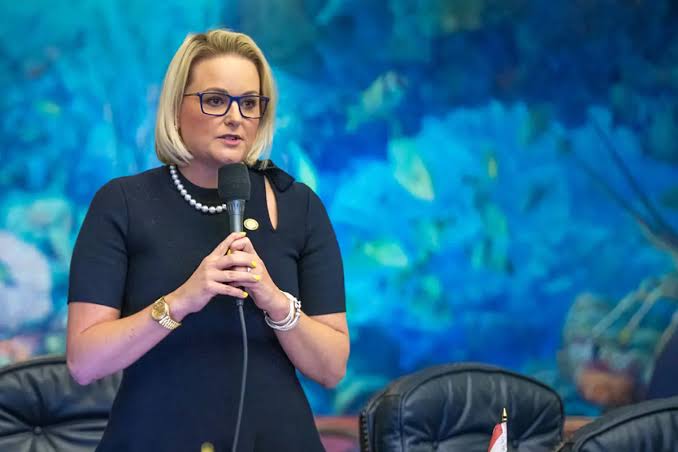
Florida State Representative Hillary Cassel has introduced new legislation called the “No Sharia Act,” aiming to strengthen constitutional protections within the state’s legal system. The bill would ensure that no Florida court or arbitration body can enforce rulings or agreements rooted in foreign laws that infringe on the rights of American citizens.
The measure, officially designated as House Bill 119 (HB 119), seeks to codify a clear prohibition against applying foreign legal codes—such as Sharia law—in civil disputes if doing so would undermine the constitutional guarantees provided by the U.S. Constitution or the Florida Constitution.
Under Cassel’s proposal, any state court ruling, arbitration decision, or contractual agreement found to rely on foreign law would be deemed invalid if it denies any party’s fundamental rights. These include due process, equal protection, freedom of speech, and the free exercise of religion.
The bill further prevents Florida courts or administrative agencies from transferring or handling civil cases in any manner that would result in the application of foreign law that conflicts with constitutional rights. Cassel’s intent, she says, is to close potential loopholes that could allow foreign legal principles to influence Florida’s judicial system.
In the language of the bill, the term “foreign law” is defined broadly to encompass any law, code, or rule originating outside of the United States. This includes decisions or rulings from international tribunals, foreign courts, or international organizations.
However, Cassel’s measure includes several notable exceptions to protect freedom of choice and religious autonomy. The bill explicitly does not interfere with religious institutions conducting internal matters in accordance with their own doctrines.
It also does not restrict private businesses or individuals who voluntarily choose to operate under foreign legal frameworks in matters such as international contracts or commercial arbitration, provided those choices do not infringe upon anyone’s constitutional rights.
Representative Cassel, who switched her political affiliation from Democrat to Republican in 2024, filed the bill on October 7, 2025. The timing of the filing was symbolic, falling on the second anniversary of the Hamas terror attacks on Israel.
Cassel used the occasion to highlight the bill’s broader message about resisting foreign extremism and reinforcing American legal sovereignty. She said the bill represents a strong statement of principle about Florida’s commitment to protecting freedom and equality under the law.
> “On October 7th, I filed legislation to make one thing crystal clear: Florida will never submit to foreign law, including Sharia law, in any form, at any time, under any circumstance,” Cassel declared in a public statement.
Cassel, who is Jewish, emphasized that the bill is not meant as a reaction to any specific event but as a preventive measure to safeguard Florida’s legal system from future threats. She said the legislation aims to preserve the integrity of American law from ideologies that “reject freedom and deny basic human rights.”
> “This bill draws a hard, immovable line: Florida’s laws are written by Americans, for Americans,” she said. “This is the free state of Florida—and I intend to keep it that way.”
The representative shared her statement on social media, including an image of her official announcement with the caption reaffirming Florida’s independence from any foreign or non-constitutional legal system. Her message quickly circulated among conservative networks, earning both praise and criticism.
While Cassel’s proposal has not yet attracted a Senate sponsor, political analysts expect a companion bill to be introduced soon. Given the Republican supermajority in both chambers of the Florida Legislature, the measure could gain momentum when the next session begins.
If approved by lawmakers, the “No Sharia Act” would officially take effect on July 1, 2026, making it one of the most explicit state-level rejections of foreign legal influence in the United States. The Florida legislative session is scheduled to begin on January 13, 2026, when lawmakers will first consider the proposal.
Cassel’s bill, she says, is ultimately about preserving the foundational principles of liberty and equality. “Florida’s legal system must answer only to the Constitution,” she said, “and that is the way it will stay.”