California voters delivered a decisive result on Tuesday, approving Proposition 50, a high-profile ballot initiative that will temporarily overhaul the state’s congressional map. The measure is expected to shift several House seats toward Democrats, strengthening the party’s standing in Congress at a time when national control is deeply contested.
With more than 65 percent of ballots counted, over 64 percent of voters supported the initiative, according to the Associated Press. The result marks one of the most significant state-level responses yet to nationwide battles over redistricting and voting power.
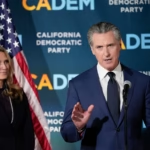
Governor Gavin Newsom, who forcefully campaigned for the measure, celebrated the outcome as a direct pushback to what he described as efforts led by President Donald Trump to tilt electoral systems ahead of the 2026 midterms. Newsom argued that the measure was not simply political strategy, but a defense of democratic norms.
In his victory remarks, Newsom cast the vote as a clear reaction to Trump’s influence on state legislatures and election policy. “Tonight, after poking the bear, this bear roared,” he said, pointing to unusually high turnout for a special election. He emphasized that the stakes were bigger than California alone: “This is about whether we protect free and fair elections in this country.”
Newsom accused the president of engaging in actions designed to intimidate and weaken political opposition, citing moves such as sending military and National Guard personnel into Democratic-led cities during moments of civil unrest. He argued these efforts formed part of a “pattern” of attempting to consolidate political power outside normal democratic checks.
“Donald Trump does not believe in free and fair elections,” Newsom said. “And we are not going to sit back and allow the democratic process to be rewritten from the top down.”
Under Proposition 50, California will adopt new congressional lines through the remainder of the decade. In 2030, the authority to draw district maps will return to the state’s independent redistricting commission, which has historically been praised as one of the fairest and least partisan processes in the United States.
The move was prompted by developments in Texas, where lawmakers — encouraged by President Trump — initiated a rare mid-decade redistricting effort projected to give Republicans up to five new House seats. California officials described Prop 50 as a direct answer to that shift, ensuring that Democrats would not lose ground nationally due to unilateral changes in other states.
Newsom had previewed this rationale months earlier. “We’re neutralizing what occurred,” he said when signing the legislation to place Prop 50 before voters. “When everyone plays by the same rules, there is no doubt the Republican Party becomes the minority in the House.”
Republicans in California, however, argue the measure amounts to partisan manipulation disguised as principle. They say the initiative will further weaken representation for conservative and rural communities already struggling to maintain influence in the state.
Critics contend that Prop 50 could all but eliminate competitive districts, effectively ensuring that Democrats dominate nearly all of California’s 52 House seats. Republican leaders warned that such moves could deepen political divides rather than protect democracy.
But Newsom countered that the measure is not about partisanship, but parity. “We are responding because others have already escalated,” he said. “If other states reverse course, California will too. But we will not unilaterally disarm.”
With the measure now passed, the stage is set for a broader national confrontation over redistricting — a conflict that will shape congressional power, campaign strategy, and political messaging heading into the pivotal 2026 midterm elections.