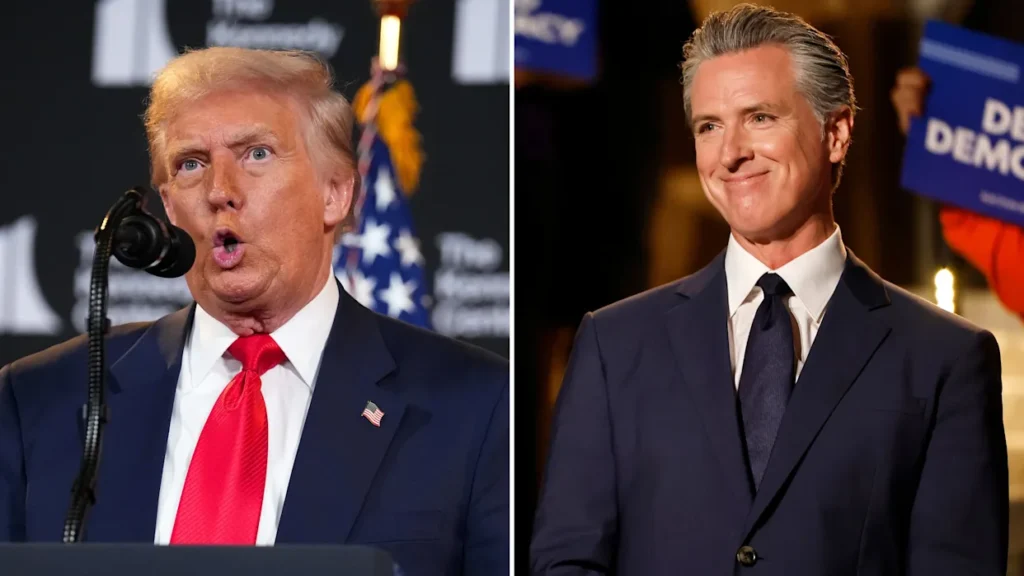
California Governor Gavin Newsom announced on Sunday that he intends to take legal action against the Trump administration after President Trump ordered 300 members of the California National Guard to be deployed to Portland, Oregon. The move came just one day after a federal judge blocked the administration from mobilizing Oregon’s own National Guard for the same mission.
Newsom condemned the president’s directive as an extraordinary misuse of power, accusing Trump of treating the military like a political tool. “This isn’t about protecting the public—it’s about power,” the governor said in a statement. “The commander-in-chief is abusing his authority and undermining the rule of law by sending troops across state lines without consent.”
The White House confirmed that 300 federally activated Guard troops from California were being sent to Portland to “protect federal assets and personnel” following what officials described as violent unrest at a federal immigration facility. In a statement, White House spokesperson Abigail Jackson said President Trump “exercised his lawful authority” to safeguard law enforcement and federal property in the city.
The decision, however, has drawn widespread criticism from Oregon officials and local leaders. Oregon Governor Tina Kotek said she was aware of at least 101 California Guard members already arriving in the state overnight and believed more were on their way, even though her office had not been officially notified. “The facts haven’t changed,” Kotek said. “There is no insurrection in Portland, and no justification for federal military intervention.”
Portland Mayor Keith Wilson also criticized the deployment, saying it “circumvents the court’s decision” and risks reigniting tensions in a city that had recently seen its demonstrations remain peaceful. He warned that the administration’s move could “further inflame” the community and undermine local authority.
The legal dispute stems from a ruling issued Saturday by U.S. District Judge Karin Immergut, a Trump appointee, who granted a temporary restraining order blocking the deployment of Oregon National Guard soldiers to Portland. The judge found that the administration had failed to prove that local police could not handle the protests and said Trump’s determination was “untethered to the facts.” The Justice Department quickly filed an appeal seeking to overturn her decision.
President Trump responded angrily to the ruling, criticizing Judge Immergut despite having appointed her himself. “I appointed the judge, and she goes like that,” Trump told reporters outside the White House on Sunday, expressing disbelief at her decision to halt the deployment.
The dispute marks another escalation in the ongoing feud between Trump and Democratic governors, especially those in states like California and Oregon that have repeatedly clashed with his administration over immigration enforcement and the use of federal force. Earlier this year, Trump mobilized National Guard units and Marines in response to protests in Los Angeles and later sent troops into Washington, D.C. He also recently called up 300 Guard members in Illinois as tensions with major U.S. cities continue to rise.
Legal experts say Newsom’s lawsuit could set a major precedent in determining the limits of presidential authority to deploy state-based military units without approval from governors. The case also raises questions about federal overreach and whether the administration can override state control in domestic law enforcement matters.
As the situation develops, both California and Oregon officials are bracing for another high-stakes legal battle with Washington. For Newsom, the lawsuit is not only about restraining federal power—it’s about defending state sovereignty. “We cannot allow the president to turn America’s military against its own people,” he said. “This is not leadership; it’s an attack on democracy itself.”