National Guard troops from Texas have been deployed to the outskirts of Chicago, marking one of the most aggressive domestic military movements under President Donald Trump’s renewed law-and-order agenda. According to federal and local sources, the troops could be sent to Memphis, Tennessee, by the end of the week as part of the administration’s wider push to address urban crime — a move that has stirred legal and political battles across several states.
By early Wednesday, Guard members had settled into an Army Reserve facility in Elwood, Illinois, roughly 55 miles southwest of downtown Chicago. Trucks marked “Emergency Disaster Services” were seen unloading portable toilets, fencing, and trailers, suggesting that troops are preparing for a longer stay. Reporters from The Associated Press confirmed that some troops were wearing uniforms displaying Texas National Guard patches.
The deployment comes despite a lawsuit filed by Illinois officials and Chicago leaders, who argue that President Trump’s actions represent a “political occupation” of their state. Illinois Governor JB Pritzker has accused the administration of using troops as “pawns” in a political strategy to project strength ahead of the 2026 midterm elections. Pritzker also said that neither he nor city officials received prior notice from Washington before the troops arrived.
President Trump, however, has defended his actions, framing them as a necessary step to restore order in what he described as “lawless and dangerous cities.” In multiple public statements, Trump has referred to Chicago as a “hell hole of crime,” though police data shows that major crimes, including homicides, have significantly decreased in 2025 compared to previous years.
The administration’s motives remain ambiguous. Federal officials have suggested that the National Guard’s role will be to “support local law enforcement” and assist U.S. Marshals in crime-fighting operations. Tennessee’s Republican Governor Bill Lee said that the troops will be “deputized by the U.S. Marshals Service” once they arrive in Memphis, but admitted that the exact nature of their duties has not been clearly defined.
Memphis Police Chief Cerelyn Davis told the City Council that Guard commanders were already in the city preparing for troop arrival. She acknowledged that her department feels “the difference” in daily operations, describing a noticeable shift in call volume and crime trends. “We still have a large call volume,” she said, “but not as many aggravated assaults or homicides.”
The Trump administration’s broader deployment plan has extended to at least ten U.S. cities, including Los Angeles, Oakland, Baltimore, New Orleans, and Washington, D.C. In each case, the White House has cited concerns about violent crime and immigration enforcement. Critics, however, see the moves as an attempt to assert federal dominance over Democratic-led urban centers.
Illinois and Chicago have filed an emergency motion seeking a restraining order to stop what they described as “Trump’s long-declared war on blue states.” A federal hearing is scheduled for Thursday, where lawyers for the state will argue that the president has violated the Posse Comitatus Act, which restricts the use of the military for domestic law enforcement without explicit congressional approval.
Legal experts say that while the Posse Comitatus Act generally prevents the military from engaging in civilian policing, Trump could attempt to invoke the Insurrection Act. The law, dating back to 1807, gives the president power to deploy troops domestically during times of rebellion or obstruction of federal law. However, invoking it has historically sparked public controversy and intense legal scrutiny.
Adding to the tension, the Federal Aviation Administration has imposed flight restrictions over the Army Reserve base in Elwood through December 6, citing security concerns. The move further signals the federal government’s intention to maintain a strong presence in the area for the foreseeable future.
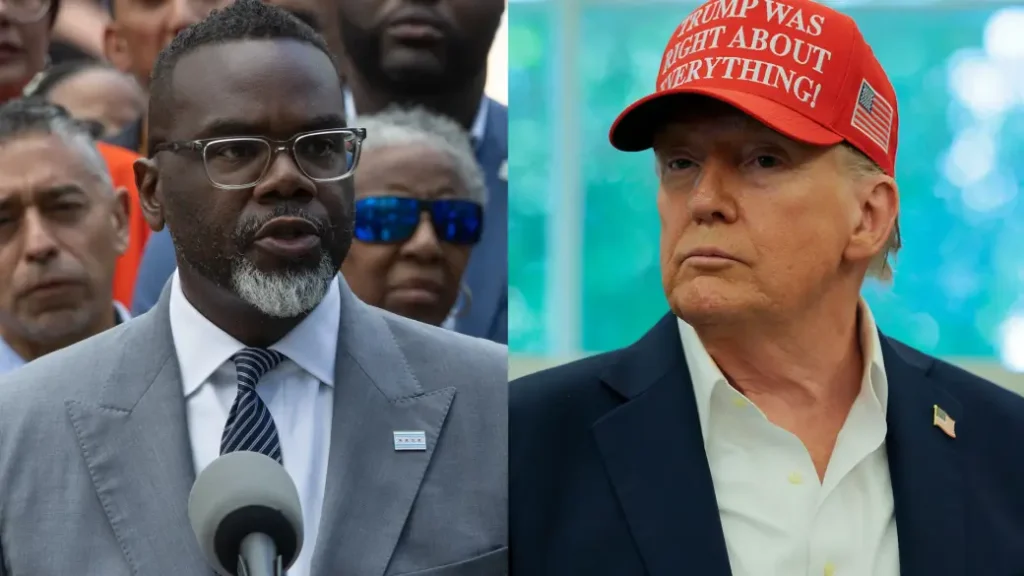
Meanwhile, Chicago Mayor Brandon Johnson has signed an executive order banning federal agents and immigration authorities from using city-owned property for enforcement operations. The order comes amid growing concern that the National Guard presence may be tied to expanded immigration crackdowns that began last month across several U.S. cities.
Civil rights organizations and immigrant advocacy groups have expressed alarm at reports of armed Border Patrol agents making arrests near major landmarks in immigrant-heavy neighborhoods. “This looks more like a show of political force than a security operation,” said one advocacy spokesperson. “Communities are terrified.”
In Oregon, similar deployments have already faced judicial roadblocks. Over the weekend, a federal judge temporarily blocked the administration’s plan to send Guard troops into Portland, ruling that the move violated state sovereignty. Oregon Governor Tina Kotek has repeatedly said there is “no insurrection” in her state, pushing back against Trump’s legal justification.
Despite these mounting challenges, the White House remains firm. Department of Homeland Security Secretary Kristi Noem told Fox News that the administration is prepared to send “four times the number of officers” to any city that fails to “adequately secure federal facilities.” Noem added that “lawless protests and local inaction” would not be tolerated under Trump’s leadership.
As the debate intensifies, the political divide over Trump’s domestic deployments continues to widen. Supporters argue that federal intervention is long overdue to restore order and deter crime. Opponents, however, warn that the president’s strategy represents a dangerous erosion of federal boundaries and a threat to civil liberties.
With National Guard troops now stationed near Chicago and on standby for Memphis, all eyes are on Thursday’s court hearing. The outcome could determine not only the future of this deployment but also the limits of presidential power in America’s cities.