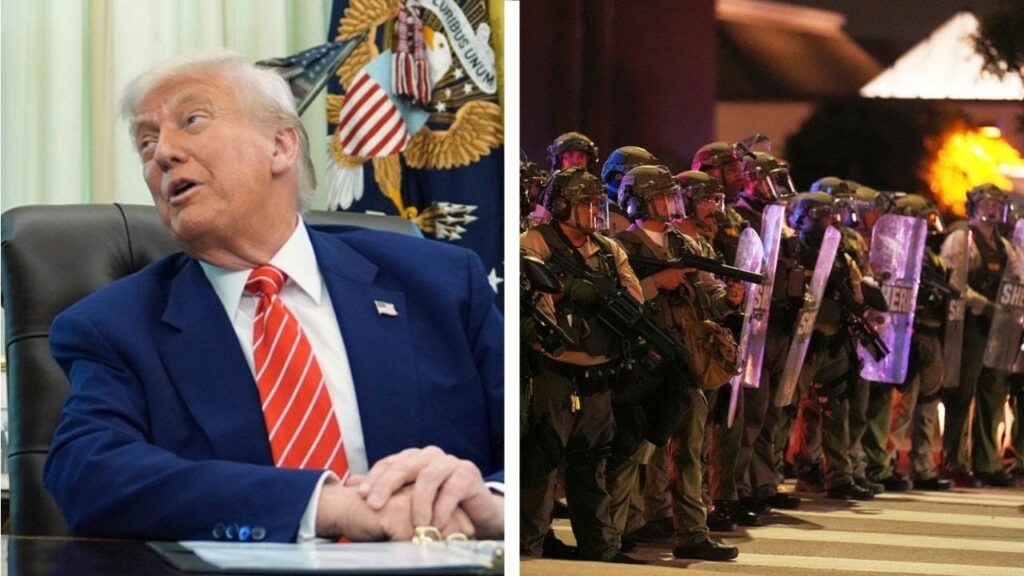
A federal judge in Oregon sharply rebuked the Trump administration on Sunday night, extending a restraining order that bars the deployment of National Guard troops from other states into Oregon.
The ruling came amid the administration’s efforts to bypass earlier judicial limits by summoning Guard forces from Texas and California for missions tied to immigration enforcement and protection of federal property.
Originally, the administration had sought to send California’s National Guard into Oregon, but Judge Karin Immergut—heralded as a Trump appointee—declared that move would defy her order. She broadened the injunction to cover “the relocation, federalization or deployment of members of the National Guard of any state … in the state of Oregon,” and criticized the administration for acting in “direct contravention” of the court’s prior ruling.
With the Oregon route blocked, the administration turned to Texas, directing some 400 members of the Texas National Guard to be federally deployed to cities including Portland and potentially Chicago. The stated aim was to support Immigration and Customs Enforcement operations and protect federal assets, though the move has generated strong backlash from Democratic leaders.
In Chicago, Gov. J.B. Pritzker condemned the plan, asserting that Texas troops would escalate, not calm, tensions. He warned that the administration might next try to mobilize Illinois’s own Guard forces against the governor’s will. Pritzker added that he had received no coordination from Washington and accused the move of inflaming strife in already polarized settings.
California’s governor, Gavin Newsom, joined Oregon’s governor, Tina Kotek, in decrying the forced reallocation of California’s Guard units. They called it a legal overreach, arguing that the forces belonged to their states—not to the president. Newsom affirmed that the court’s ruling would result in California troops returning home.
The legal tension centers around whether the president may federalize one state’s National Guard, bypass state governors, and send those troops into another state without consent. While federal law does grant the president certain powers over Guard troops (especially when federalized), Judge Immergut found that key statutory conditions were unmet in Portland. She concluded that recent protests were not sufficiently violent or disorderly to justify such a deployment, and that the federal government had not shown it had met legal thresholds.
Though the court’s order currently applies only to troop deployment in Oregon, legal observers say its reasoning may extend more broadly—and could imperil efforts to use out-of-state Guard units in other cities. The administration’s broader push to deploy troops to cities run by Democratic leadership has already sparked fierce opposition, with critics accusing the White House of weaponizing the military against political rivals.
Amidst declarations of “invasion” by some state officials, the standoff underscores deep institutional conflicts over federal authority, state sovereignty, and the constitutional limits on the use of military forces in domestic affairs.