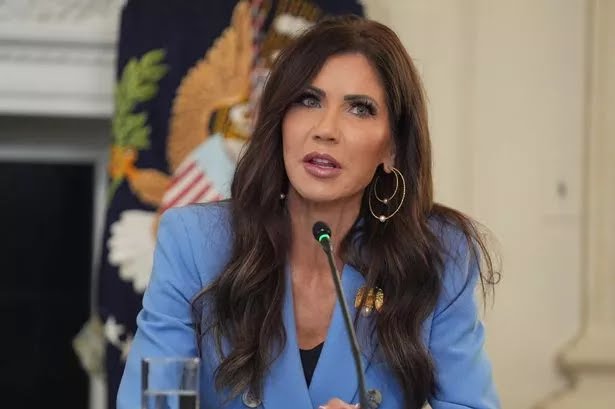
Kristi Noem, the U.S. Secretary of Homeland Security and former Governor of South Dakota, has once again become the center of national debate following her bold and controversial statements regarding immigration and national security. In recent remarks, she publicly called for a sweeping “full travel ban” targeting what she described as “every damn country that’s been flooding our nation with killers, leeches, and entitlement junkies.” The statements come in the wake of a tragic shooting near the White House in Washington, D.C., involving an Afghan national, which resulted in the death and injury of members of the National Guard.
Noem made her comments on social media, specifically on X (formerly Twitter), framing the proposal as a necessary measure to protect the United States from violent crime and what she perceives as uncontrolled immigration. She said that she had met with former President Donald Trump to urge the immediate implementation of this policy. Her language was forceful and uncompromising, with statements such as “WE DON’T WANT THEM. NOT ONE,” emphasizing her hardline stance.
The timing of her announcement is particularly notable. The D.C. shooting, in which the suspect entered the country under refugee or asylum protocols, ignited national discussions about the effectiveness of immigration vetting processes. Noem has argued that the suspect was radicalized after arriving in the United States, suggesting that existing resettlement programs and vetting procedures are insufficient to prevent such incidents. This assertion has drawn attention to potential gaps in national security and has been used by Noem to justify her proposed travel ban.
Her proposal, while dramatic, is marked by a lack of specific details. Noem has not identified which countries would be subject to the ban or the criteria for selection, leaving many questions about the practical implementation of such a sweeping policy. This vagueness has drawn criticism from legal experts, immigrant advocacy groups, and policymakers who warn that a blanket ban targeting entire nations could violate constitutional and international laws, including human rights protections and asylum obligations.
Critics have also taken issue with Noem’s rhetoric, noting that describing immigrants as “killers” and “leeches” dehumanizes entire groups of people and risks inflaming xenophobia. Humanitarian organizations have voiced concern that such language could undermine America’s long-standing commitment to providing refuge to those fleeing persecution, war, or natural disasters. Furthermore, a ban of this scale would inevitably affect countless innocent individuals seeking safety, education, or employment in the United States, raising ethical and legal questions about collective punishment.
Supporters of Noem’s stance argue that her proposal is a decisive action to safeguard national security. They contend that the recent shooting in Washington, D.C., underscores the importance of stricter immigration controls and thorough vetting processes. In their view, her recommendations reflect a necessary prioritization of citizen safety and a response to real threats posed by inadequately screened entrants. These supporters applaud her direct approach and willingness to challenge the status quo in U.S. immigration policy.
The political implications of Noem’s statements are significant. As a high-profile Republican leader and close ally of Donald Trump, her proposals carry considerable weight within conservative circles and could influence broader policy decisions at both the federal and state levels. The bold nature of her remarks may serve to consolidate support among constituents who favor stricter border control and immigration enforcement, while simultaneously sparking legal challenges and criticism from opposition parties and advocacy groups.
In response to the D.C. incident and the ensuing public outcry, the administration has already taken steps such as pausing asylum decisions for certain groups, reviewing green-card holders from 19 “countries of concern,” and halting visa issuance for some nationals. Noem’s recommendations appear to build on these measures, advocating for an even broader approach to restricting entry from countries perceived as high-risk. The proposal, however, leaves many unanswered questions about how such policies would be implemented and enforced without infringing on legal and human rights standards.
Legal scholars have emphasized that implementing a blanket travel ban would likely face immediate judicial scrutiny. Past instances of similar policies, such as the travel restrictions imposed during previous administrations, were challenged in federal courts and required careful legal justification. A ban of the scale Noem proposes — especially one targeting unspecified countries — could encounter numerous obstacles, including challenges based on discrimination, due process violations, and conflict with international refugee conventions.
Beyond the legal considerations, the humanitarian impact of such a ban could be profound. Millions of individuals currently seeking asylum, refugee status, or other forms of legal immigration could be affected, potentially leaving vulnerable populations without protection. Critics warn that policies implemented without careful consideration of these human costs could damage the United States’ international reputation and strain diplomatic relations with countries whose citizens are affected.
The proposal also has significant implications for domestic political discourse. Noem’s rhetoric and recommendations highlight the growing polarization around immigration in the United States, with stark divisions between those advocating for tighter border controls and those emphasizing human rights and refugee protection. Her public statements, characterized by confrontational language, may further deepen these divides and fuel political tensions.
Moreover, Noem’s approach signals a potential shift toward more aggressive immigration policy in the Trump administration. Observers note that the combination of her high-profile position, the recent violent incident, and the administration’s broader security agenda creates a context in which sweeping changes to U.S. immigration law could be proposed and possibly implemented. The proposal reflects a broader strategy to prioritize security over humanitarian considerations and to emphasize a nationalistic approach to border control.
Despite the strong reactions her statements have generated, key details remain unclear. It is unknown which countries would be specifically targeted by the proposed travel ban, how it would be enforced, and what exceptions, if any, would be granted for refugees, students, or other legitimate entrants. Without clarification, the policy remains largely symbolic, serving as a political statement rather than a concrete plan of action.
Internationally, the proposal could have wide-reaching consequences. Countries potentially affected by a broad ban may view it as punitive, damaging diplomatic relations and international cooperation on security and immigration matters. Additionally, organizations such as the United Nations and human rights groups may condemn the policy, framing it as inconsistent with global norms and conventions regarding the protection of displaced persons.
The discussion surrounding Noem’s proposal underscores the complex balance between national security, legal obligations, and humanitarian responsibility. While there is broad consensus on the need to protect citizens from genuine threats, the means by which this is achieved are hotly contested. The debate illustrates the challenges of crafting immigration policy that simultaneously addresses security concerns, complies with legal standards, and respects the rights of vulnerable populations.
In conclusion, Kristi Noem’s call for a sweeping travel ban reflects a highly controversial and polarizing approach to immigration and national security. While supporters praise her decisive stance, critics raise concerns about legality, morality, and human rights. The policy’s lack of specificity and potential for broad impact make it a flashpoint in ongoing debates over U.S. immigration law, refugee protection, and national security. As lawmakers, courts, advocacy groups, and the public respond, the proposal is likely to remain a major point of discussion and controversy in the coming weeks.