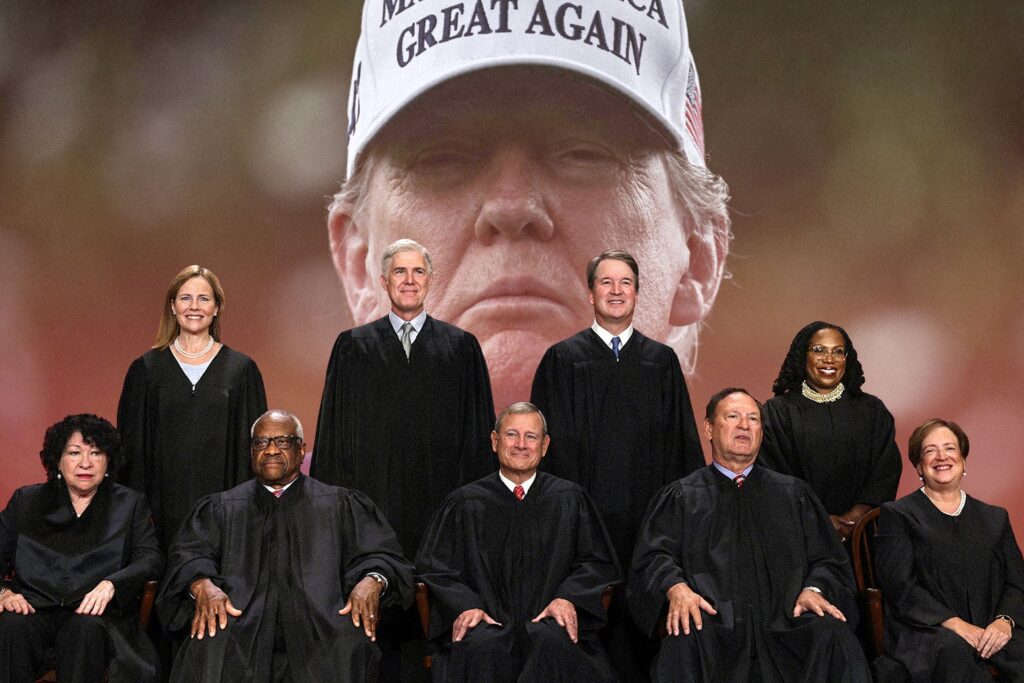
The Supreme Court signaled Monday that it is leaning toward striking down a federal law that limits the president’s ability to remove Federal Trade Commission members. After more than two hours of arguments in Trump v. Slaughter, a majority of justices appeared to agree with the Trump administration’s view that the rule—allowing FTC commissioners to be fired only for “inefficiency, neglect of duty, or malfeasance”—violates the Constitution’s separation of powers.
Although several justices criticized the 1935 precedent Humphrey’s Executor v. United States, which upheld the FTC’s protections, it was unclear whether enough of them were ready to overturn it outright.
A ruling for Trump would significantly strengthen presidential control over not just the FTC, but about two dozen other independent agencies. Trump has already dismissed members of the NLRB, MSPB, and the Consumer Product Safety Commission, with the Supreme Court permitting those removals to stand temporarily. The Slaughter case will determine, once and for all, whether those firings were lawful.
How the case began
The FTC has five commissioners who serve seven-year staggered terms, and no more than three may belong to the same political party. Trump originally nominated Rebecca Slaughter to a Democratic seat, and Biden reappointed her for a second term ending in 2029.
But in March, President Trump emailed Slaughter, firing her without citing any statutory grounds—only saying that keeping her in office did not align with his administration’s priorities.
Slaughter sued, and a federal district judge ordered her reinstated. A divided D.C. Circuit panel refused to pause that ruling, pointing to Humphrey’s Executor as controlling precedent. The Trump administration appealed to the Supreme Court, which allowed the firing to take effect and agreed to hear the case.
Arguments before the Court
Solicitor General D. John Sauer argued that Humphrey’s Executor is an outdated and unsound decision that should be discarded, insisting modern case law has undermined its foundation.
Representing Slaughter, attorney Amit Agarwal countered that the president’s duty to enforce the law does not give him the power to ignore statutory limits. If the Trump administration is right, he said, all three branches have misunderstood executive power for more than two centuries.
Concerns from the Justices
The justices spent significant time considering the broader impact of their ruling.
Some worried about Congress gaining too much power.
Chief Justice John Roberts suggested Congress might even convert Cabinet agencies into independent commissions. Agarwal conceded this was theoretically possible, though unlikely. Justice Brett Kavanaugh warned that such power could allow Congress to “thwart future presidents” by creating long-term, politically unbalanced agencies.
Others warned of the opposite risk.
A ruling for Trump could jeopardize the structure of many other bodies, including the Tax Court and Court of Federal Claims. Justice Sonia Sotomayor said those institutions could be “at risk,” and Justice Elena Kagan agreed the administration’s argument was extremely far-reaching.
Justice Samuel Alito, however, floated a narrower ruling that would apply only to the FTC, a possibility Sauer said would be permissible.
Will the Court overturn Humphrey’s Executor?
Many justices seemed comfortable saying the president can remove FTC commissioners, but it was uncertain whether they would go so far as to scrap the 1935 precedent entirely.
Democratic-appointed justices strongly opposed overturning it. Sotomayor pressed for an example of the Court ever discarding such an old and foundational decision. Meanwhile, Barrett noted the decision has been steadily weakened over time; Roberts suggested it has withered into a “dried husk,” and Gorsuch called it “poorly reasoned.”
Second issue gets little attention
The justices barely addressed the secondary question: if the removal law is valid, can a court order the reinstatement of an improperly fired commissioner, or only award back pay?
Kavanaugh expressed doubts about the government’s argument that reinstatement is never allowed, warning it would let presidents evade the law. But if the Court rules for Trump on the main question—as the justices seemed inclined to do—they won’t need to reach this issue at all.
A final decision is expected in late June or early July.