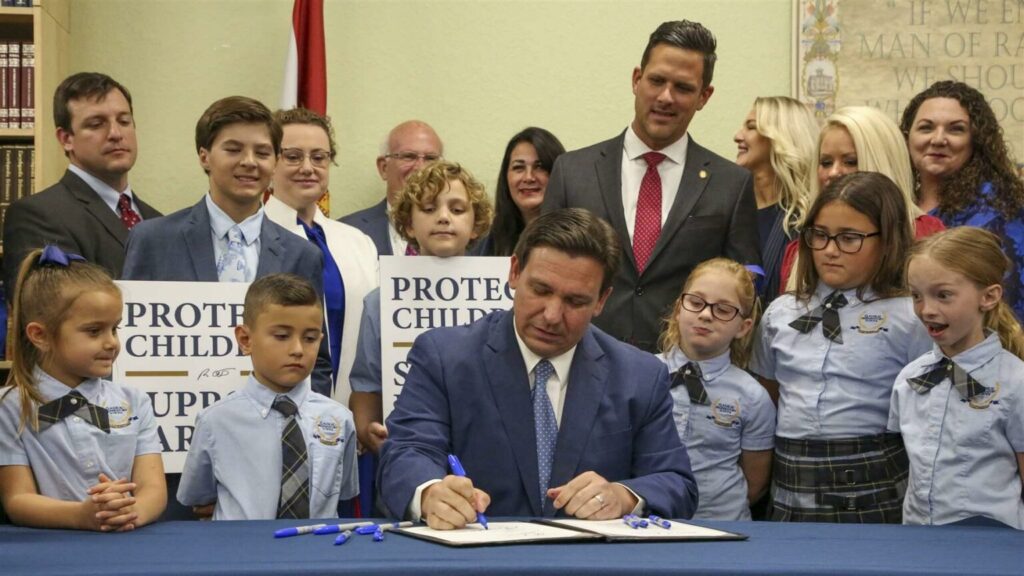
Florida has positioned itself at the center of a significant national legal debate with the implementation of a new law that permits prosecutors to seek the death penalty for adults convicted of sexually assaulting children under the age of 12. The law, signed by Governor Ron DeSantis in May 2023, officially went into effect on October 1, 2023, and represents one of the most aggressive criminal sentencing policies in the United States.
Under the measure, prosecutors may pursue capital punishment even when the victim survives the assault, a move that directly challenges long-standing federal legal precedent. The legislation passed with strong support from Republican lawmakers, who argued that crimes involving the sexual abuse of young children warrant the most severe possible punishment.
“If you hurt a child in Florida, we are coming for you,” DeSantis said at the signing ceremony.
“Some crimes are so horrific that the penalty must match the damage done to innocent life.”

A Direct Challenge to Supreme Court Precedent
The new policy is expected to face immediate and intense legal scrutiny because it stands in conflict with the 2008 U.S. Supreme Court decision Kennedy v. Louisiana. In that ruling, the Court held that the death penalty violates the Eighth Amendment when applied to crimes where the victim does not die. The justices concluded that capital punishment should be reserved for cases involving homicide.
By allowing execution for non-homicide offenses, Florida is effectively testing whether the current Supreme Court — with a different ideological makeup than in 2008 — is willing to reconsider or overturn that earlier decision.
Constitutional law professor Mary Ziegler explains:
“Florida knows this legislation conflicts with established precedent. The intent is to invite a legal challenge that could bring the question back before the Supreme Court.”
How the Law Works
The law applies only when:
-
The victim is under 12 years old, and
-
The offender is 18 or older, and
-
The prosecutor chooses to seek death rather than life imprisonment.
A jury must recommend the death penalty by at least an 8–4 vote — a threshold lowered from the previously required unanimous jury decision under other capital sentencing laws.
Prosecutors Already Moving to Use the Law
Shortly after the law took effect, state prosecutors in Escambia County announced their intent to seek the death penalty against a defendant accused of sexually assaulting a young child. This case will likely become the first legal battleground for testing the constitutionality of the statute.
Defense attorneys in the case are expected to argue that the law is unconstitutional, citing Kennedy v. Louisiana. Should a trial court rule the law invalid, the state will almost certainly appeal, sending the issue through the state court system and likely toward federal review.
Supporters Say the Law Protects Children
Advocates for the law assert that current penalties — which include life imprisonment without parole in many cases — are not enough.
“A life sentence means the perpetrator still gets to live,” said Republican lawmaker Jessica Baker, who sponsored the bill.
“Victims live with trauma forever. Punishment must reflect that reality.”
Victim advocacy groups have largely supported the effort, arguing that harsher consequences could also serve as a deterrent.
Opponents Raise Constitutional and Ethical Concerns
Opponents argue that the death penalty in such cases may:
-
Violate constitutional protections against “cruel and unusual punishment”
-
Reduce reporting rates, particularly in abuse cases involving family members
-
Increase the likelihood of wrongful convictions in emotionally charged trials
The American Civil Liberties Union (ACLU) stated:
“This law is unconstitutional and risks further harm to children by discouraging victims from coming forward, especially when the abuser is a parent or guardian.”
The Road Ahead
Legal experts widely agree that the Florida law is designed not just to punish offenders, but to force a national reexamination of how the justice system handles the most severe forms of child sexual violence.
Whether the law ultimately stands will likely be decided not in Tallahassee courtrooms, but by the U.S. Supreme Court.
If the Court upholds Florida’s statute:
-
Other states could pass similar laws.
-
The scope of the death penalty in America would expand for the first time in decades.
If the Court strikes it down:
-
Florida’s law will be invalidated.
-
The Kennedy precedent will remain firmly in place.
Either outcome would have major nationwide implications for criminal sentencing and constitutional law.