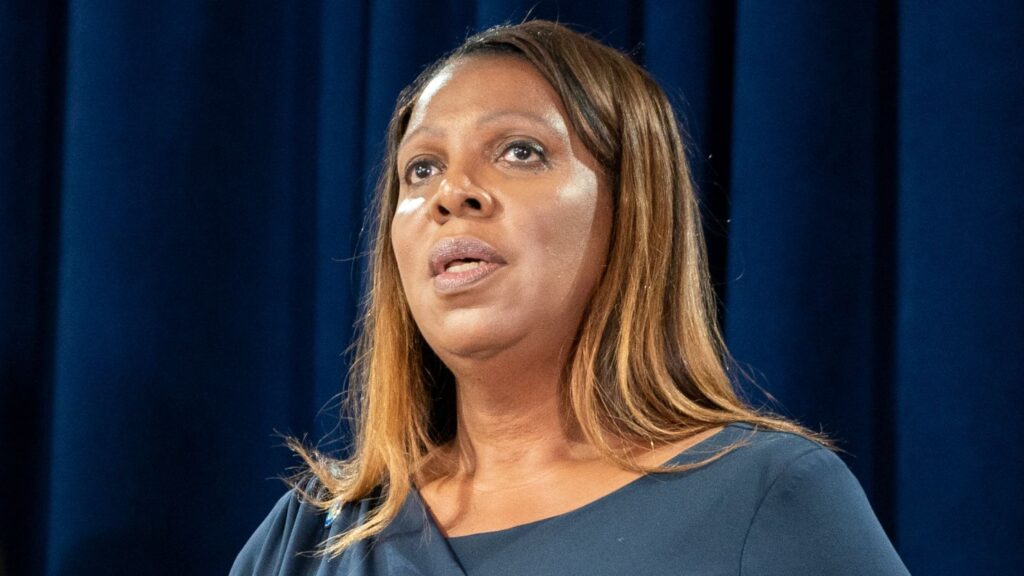
New York Attorney General Letitia James has filed a legal challenge against the Trump administration’s subpoenas, arguing that the acting U.S. attorney overseeing the investigation into her office’s cases against Donald Trump and the National Rifle Association was improperly appointed and lacks the authority to issue them.
According to court documents unsealed Friday, James moved in August to block subpoenas issued by John Sarcone, the acting U.S. attorney for the Northern District of New York, who sought records related to her civil lawsuits targeting Trump’s business empire and the NRA.
James — a Democrat who has long been a vocal critic of Trump — accused the administration of retaliation, saying the Justice Department’s probe represents “an abuse of power” designed to punish her for taking on the former president.
“The Justice Department is being weaponized to intimidate public officials and obstruct justice,” James’ office said in a statement.
Challenging the Legitimacy of the Prosecutor
Central to James’ motion is her claim that Sarcone’s appointment violated federal law, effectively rendering his subpoenas void. She argues that former Attorney General Pam Bondi, who succeeded Trump’s earlier appointees, improperly extended Sarcone’s tenure beyond the 120-day interim period allowed under the law by reclassifying him as “first assistant U.S. attorney,” thereby enabling him to act in the same role indefinitely.
James contends this maneuver sidestepped Senate confirmation requirements, undermining the legitimacy of his actions.
Unsealed Court Documents Reveal Broader Dispute
Federal Judge Lorna Schofield on Friday granted James’ motion to unseal most of the court filings, despite objections from the Justice Department. “Unsealing this action is not only permissible but compelled,” Schofield wrote. “One simple fact drives this conclusion: the information at issue is not secret.”
The ruling opens public access to months of sealed legal exchanges between James’ office and federal prosecutors — though the judge has not yet ruled on whether to formally quash the subpoenas themselves.
Emails and calls to Sarcone’s office were not immediately returned Friday evening.
Tensions Between James and Trump Administration Escalate
James’ clash with the Trump administration adds another chapter to a long and contentious relationship. Since taking office, she has filed dozens of lawsuits against Trump and his allies — ranging from challenges to immigration and environmental policies to the high-profile civil fraud case accusing Trump of inflating his assets to secure loans and tax benefits.
The Trump administration, in turn, has targeted James personally. In October, James was indicted in a federal mortgage fraud case reportedly pushed by Trump himself. Prosecutors alleged she falsified information on loan applications for a property in Virginia. She pleaded not guilty this week, calling the charges “politically motivated.”
Her legal team now says they intend to challenge the legitimacy of that prosecution as well — arguing that the lead prosecutor, Lindsey Halligan, was also improperly appointed after former U.S. attorney Erik Siebert abruptly resigned. Halligan, a former Trump legal adviser, personally presented the case to the grand jury despite lacking prior prosecutorial experience.
A Political and Legal Power Struggle
James’ move to block the subpoenas reflects the deepening standoff between state-level prosecutors and the Trump-aligned federal Justice Department. Her office alleges that the subpoenas are part of a coordinated campaign to discredit her ongoing investigations into Trump’s business practices and the NRA’s financial dealings.
Meanwhile, legal scholars say the dispute raises important constitutional questions about the limits of executive power and the proper process for appointing U.S. attorneys. If a court rules Sarcone’s appointment invalid, it could undermine multiple federal cases initiated under his authority.
What Comes Next
Judge Schofield’s upcoming decision on the motion to quash will likely determine the scope of federal authority in the ongoing investigation — and could set a precedent for future disputes over interim federal appointments.
For now, the battle between Letitia James and the Trump administration appears far from over, with both sides framing the case as a test of justice, accountability, and political independence.