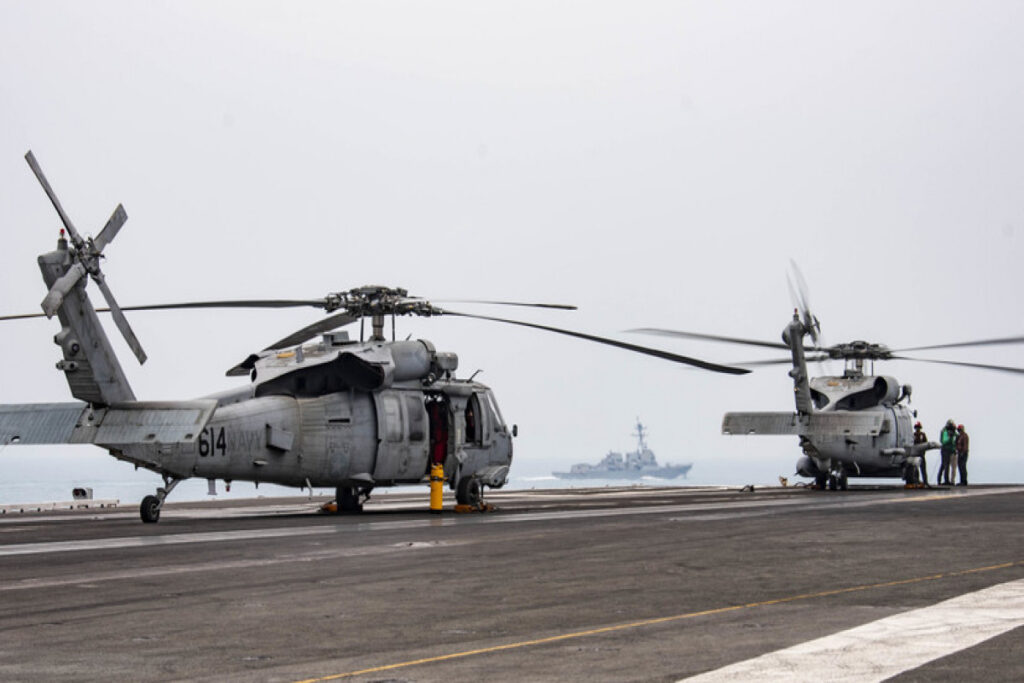
Two U.S. Navy aircraft operating from the USS Nimitz—a helicopter and a fighter jet—crashed within half an hour of each other on Sunday during separate routine missions over the South China Sea, the Navy’s Pacific Fleet confirmed. All crew members were rescued safely, and investigations are underway to determine the causes of both incidents.
According to a statement released on social media, the first incident occurred around 2:45 p.m. local time when an MH-60R Seahawk helicopter went down while conducting routine flight operations. The three crew members aboard were quickly recovered by search-and-rescue teams. About 30 minutes later, an F/A-18F Super Hornet fighter jet also crashed while operating from the same carrier. Both pilots ejected before impact and were safely rescued by recovery teams.

No injuries have been reported in either case, and the Navy emphasized that the two accidents occurred during separate flight operations and were not related. The Pacific Fleet added that both aircraft were engaged in standard training and operational exercises, part of ongoing U.S. naval patrols in the region.
A Strategic and Tense Backdrop
The crashes occurred over the South China Sea, one of the world’s most strategically significant and politically volatile maritime regions. The waterway, bordered by China and several Southeast Asian nations—including the Philippines, Vietnam, Malaysia, and Brunei—is claimed almost entirely by Beijing. Despite a 2016 international court ruling rejecting China’s sweeping claims, the Chinese government continues to assert sovereignty and has constructed artificial islands fortified with military bases, airstrips, and radar systems.
For decades, the United States has maintained a naval presence in the area to assert freedom of navigation and to reassure allies concerned about China’s territorial ambitions. The USS Nimitz, one of the largest warships ever built and the oldest active aircraft carrier in the U.S. fleet, has been central to these operations. The vessel is expected to retire next year after more than four decades of service.
Broader Diplomatic Context
The incidents occurred as President Donald Trump continued his diplomatic tour across Asia, where he is expected to meet Chinese President Xi Jinping later this week. The upcoming talks are expected to focus on stabilizing trade relations between the two powers following weeks of renewed tension.
Both governments recently imposed broad trade measures against each other, threatening to upend months of relative calm. However, U.S. Treasury Secretary Scott Bessent announced Sunday that Washington and Beijing have reached a “framework trade agreement,” easing tensions ahead of the Trump–Xi summit.
A Series of Costly Losses
The Navy’s statement did not identify any mechanical or environmental factors behind the crashes but confirmed that both aircraft have been lost. The F/A-18F Super Hornet, a twin-engine, multirole fighter valued at around $60 million, has seen a series of incidents this year. Sunday’s crash marks the fourth Super Hornet loss of 2025. Two of the jets were lost in the Red Sea earlier in the spring—one reportedly due to a failed arresting cable that caused it to roll off the carrier deck, and another during a landing mishap. A separate training flight in August off the coast of Virginia also ended in a crash, though the pilot survived.
The MH-60R Seahawk, a naval variant of the Black Hawk helicopter, is a critical platform used for anti-submarine warfare, reconnaissance, and search-and-rescue operations.
Investigations Underway
The U.S. Navy has launched parallel investigations into both incidents to determine whether mechanical issues, weather conditions, or procedural errors played a role. The Pacific Fleet confirmed there was no indication of hostile activity and stressed that safety remains a top priority.
The back-to-back crashes highlight the operational risks faced by U.S. forces maintaining an active presence in contested regions. With geopolitical tensions rising in the South China Sea, the incidents are expected to draw renewed scrutiny to U.S. military readiness and the strain placed on aging aircraft and carriers operating in high-demand theaters around the world.