President Donald Trump has taken an unusually direct approach in trying to sway the Supreme Court as it prepares to hear arguments on his sweeping tariffs. In recent weeks, he has repeatedly warned of dire consequences if the justices rule against him, portraying the case as one of the most important in U.S. history. Speaking from the White House on October 15, Trump claimed that losing the case would leave the country “a weakened, troubled, financial mess for many years.”
The president’s comments, echoed across his public appearances and Truth Social posts, are part of a broader effort to rally public opinion—and perhaps indirectly pressure the court—before the November 5 hearing. Trump has even hinted he might attend the oral arguments in person, an unprecedented move for a sitting president. The White House has declined to confirm whether he intends to appear.
Trump’s strategy mirrors past moments when presidents publicly challenged the court. In 2012, Barack Obama faced criticism for warning that overturning the Affordable Care Act would be an “unprecedented” act, though the court ultimately upheld the law. But Trump’s remarks go further, not only emphasizing the stakes but also attacking those he accuses of trying to influence the court.
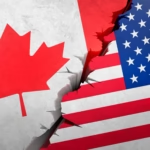
On Thursday night, Trump abruptly ended trade negotiations with Canada after accusing the country of trying to sway the justices through a provincial ad criticizing his tariffs. “They only did this to interfere with the decision of the U.S. Supreme Court,” he wrote online, blasting what he called foreign interference in America’s judicial process.
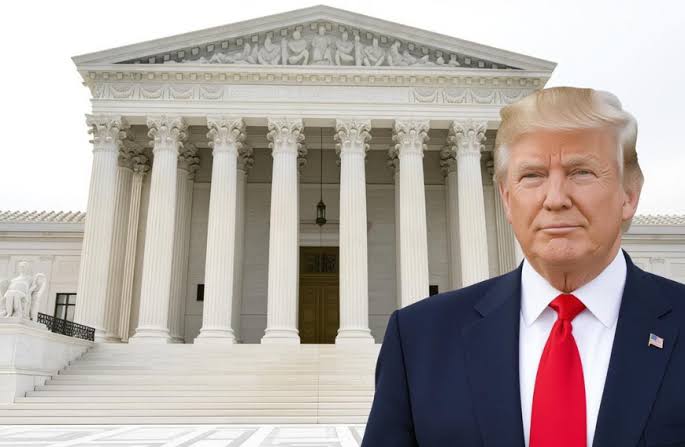
The tariffs, imposed under the International Emergency Economic Powers Act, are now at the heart of the legal battle. The law allows presidents to act in emergencies, and the court must decide whether Trump’s use of it to impose tariffs was lawful. With a conservative 6–3 majority that includes three of Trump’s own appointees, the outcome is uncertain but politically charged.
Treasury data shows the tariffs have generated more than $174 billion this year. Yet if the court rules against the administration, half of that money could be refunded, according to Treasury Secretary Scott Bessent. Critics argue that Trump’s apocalyptic rhetoric is designed to intimidate the justices and frame any ruling against him as a blow to national strength.
Legal experts across the spectrum see Trump’s remarks as an attempt to shape the court’s thinking through public pressure. Thomas Berry of the libertarian Cato Institute called it “partial intimidation,” while Elizabeth Goitein of the Brennan Center for Justice said the comments are “clearly aimed at influencing the Supreme Court.”
Oregon Attorney General Dan Rayfield, one of the state officials challenging the tariffs, said Trump is right about one thing—this is a major test of presidential power. “We can’t normalize this behavior,” he said. “We have to draw a line in the sand and hold him accountable.”
Economists, however, dispute Trump’s warnings of economic collapse. Maury Obstfeld of the Peterson Institute for International Economics dismissed his claims as exaggerated. He argued that many sectors would actually benefit if tariffs were reduced and said consumers are already paying the price through higher costs.
Reports from Goldman Sachs support that view, noting that American consumers are bearing more than half of the tariffs’ burden. Companies such as General Motors and Mattel have also warned of financial hits, and small businesses say the strain is even greater. Obstfeld added that the administration’s claims of record revenue have been overstated and used to justify a budget that would otherwise appear less sustainable.
“The job of the courts is to interpret the law, not to save the government from the consequences of its own decisions,” Obstfeld said.
Meanwhile, Trump’s solicitor general, D. John Sauer—who previously served as his personal lawyer—has filed a brief defending the tariffs in similarly fiery language. Sauer’s arguments, unusually emotional for a government filing, claim the tariffs are vital to “rectify America’s country-killing trade deficits” and combat illegal drug trafficking from nations like Mexico and Canada.
Sauer even quoted Trump directly, saying the U.S. was “a dead country” before the tariffs but is now thriving. “With tariffs, we are a rich nation; without tariffs, we are a poor nation,” the brief concludes, summarizing the administration’s stark framing of the stakes.
For Trump, the case represents both a legal and political battle—a defining test of presidential power and a chance to cement his image as the defender of American industry. As the court date approaches, his warnings have grown louder, setting up a dramatic confrontation between the judiciary and a president who has never been shy about trying to bend it to his will.