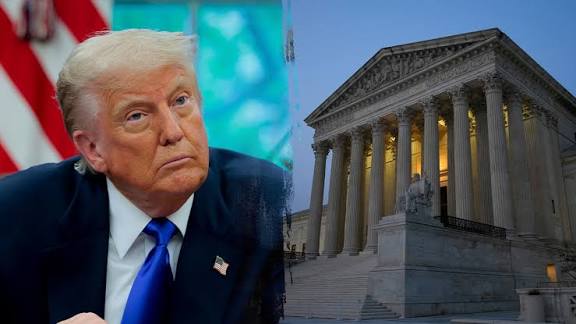
The U.S. Supreme Court is set to open a new term that could reshape the boundaries of presidential power and reignite some of the country’s most divisive cultural and constitutional debates. The nine-month term, beginning on Monday, will feature cases examining President Donald Trump’s authority over trade, federal institutions, and controversial social issues that have defined his administration’s legal and political agenda.
Among the most consequential cases is a challenge to Trump’s use of emergency powers to impose sweeping tariffs on imports. The justices will hear arguments on November 5, following a lower court ruling that said Trump overstepped his authority. The outcome could determine whether presidents can unilaterally reshape trade policy without congressional approval. According to Bradley University professor Taraleigh Davis, the stakes are immense — a loss for Trump could immediately invalidate existing tariffs and send shockwaves through markets, while a win could dramatically expand presidential control over the economy.
Another high-profile case will test the limits of presidential authority over independent federal agencies. In January, the Court will hear arguments concerning Trump’s attempt to remove Federal Reserve Governor Lisa Cook, marking the first time a president has sought to fire a sitting member of the Fed’s board.
Congress established the central bank in 1913 to operate independently of political interference, allowing removals only “for cause.” Trump’s legal team alleges that Cook engaged in mortgage fraud — a claim she firmly denies — while her supporters say the move is politically motivated due to her economic policy stance. The justices have so far declined to let Trump proceed with her removal as litigation continues.
The Court will also examine Trump’s dismissal of Rebecca Slaughter, a Democratic member of the Federal Trade Commission. This case could allow the conservative majority to revisit a nearly century-old precedent that protects certain federal officials from being fired at will by the president. Trump has already been permitted to remove Slaughter while the legal challenge unfolds, setting the stage for a significant decision about the balance of power between the presidency and independent agencies.
Beyond questions of executive authority, the new term also delves deep into America’s ongoing cultural and political divisions. On Tuesday, the justices will hear a challenge to Colorado’s ban on conversion therapy — the widely discredited practice that claims to change a person’s sexual orientation or gender identity.
A Christian counselor argues the ban violates her First Amendment right to free speech. The lower court dismissed the claim, but the Supreme Court’s conservative majority could be poised to revisit long-standing boundaries between professional regulation and religious expression.
Later in the term, the Court will take up cases from Idaho and West Virginia that seek to uphold state laws banning transgender athletes from competing on female sports teams. These cases, alongside the conversion therapy dispute, are expected to further test the Court’s approach to LGBTQ+ rights under the Trump administration.
Gun rights will also return to the docket with a challenge to Hawaii’s restrictions on carrying handguns on private property open to the public — such as stores and restaurants. The case offers conservatives another opportunity to broaden the scope of Second Amendment protections following a series of recent victories for gun owners.
Meanwhile, voting rights are once again under threat in a case concerning Louisiana’s new congressional map, which increases the number of Black-majority districts. The challenge could give the conservative justices a chance to weaken a central provision of the Voting Rights Act of 1965 — a move that civil rights advocates warn would further erode protections against racial discrimination in elections.
Another politically charged case involves Trump’s Vice President, JD Vance, and a campaign finance dispute over spending limits between political parties and candidates. Vance and other Republicans argue the restrictions violate the First Amendment, though lower courts have upheld the law.
Legal experts say the upcoming term could be one of the most politically significant in years. University of Virginia law professor Xiao Wang described it as “a term that will not only be legally important but also culturally and politically defining.” With issues ranging from presidential authority to LGBTQ+ rights and voting protections, the Supreme Court’s new term is poised to shape the contours of American law — and democracy itself — for years to come.