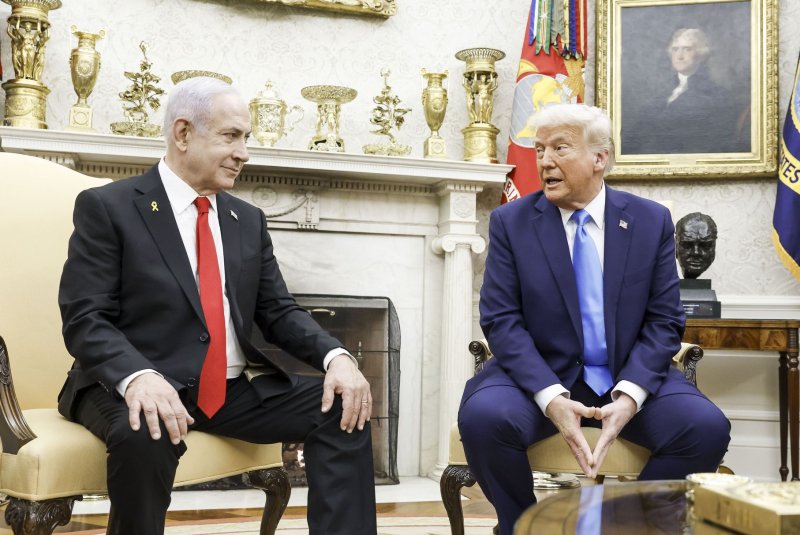
Donald Trump’s plan to end the war in Gaza has been accepted by Israeli Prime Minister Benjamin Netanyahu, while Hamas is yet to issue an official response.
Donald Trump’s Gaza Peace Proposal
1. Reconstruction efforts will focus on improving life for the people of Gaza, who have suffered greatly.
2. If both parties agree, hostilities will stop immediately. Israeli forces will pull back to designated positions to prepare for a hostage release, and all military actions will be frozen until conditions for full withdrawal are met.
3. Within 72 hours of Israel’s acceptance, all hostages—alive and deceased—must be returned.
4. After the hostages are released, Israel will free 250 prisoners serving life sentences and 1,700 Gazans detained since October 7, 2023, including women and children. For every Israeli hostage’s remains returned, Israel will release 15 Gazan remains.
5. Hamas members who renounce violence and surrender weapons will be granted amnesty. Those wishing to leave Gaza will be given safe passage to other countries.
6. Humanitarian aid will immediately flow into Gaza, covering essentials like water, electricity, hospitals, bakeries, and rubble clearance, consistent with the January 19, 2025 aid agreement.
7. Aid will be distributed freely under the supervision of the UN, Red Crescent, and other neutral international bodies. The Rafah crossing will reopen under the same January 2025 mechanisms.
8. Gaza will be temporarily administered by a technocratic Palestinian committee, supported by international experts and overseen by a new body called the “Board of Peace” chaired by Donald J. Trump, with other world leaders including Tony Blair. This body will manage reconstruction and governance until the Palestinian Authority reforms and can take over.
9. An economic development plan will be launched, drawing on global expertise in building modern cities, to attract investment, create jobs, and stimulate long-term growth in Gaza.
10. A special economic zone will be established with preferential trade arrangements negotiated with partner countries.
11. No resident will be forced out of Gaza. People may leave and return freely, but the plan will encourage them to stay and rebuild.
12. Hamas and other armed groups will be excluded from governance. All military infrastructure—tunnels, weapons, and factories—will be dismantled. A supervised disarmament and buy-back program will reintegrate former fighters.
13. Regional partners will guarantee that Gaza remains peaceful and that Hamas complies with its commitments.
14. A temporary International Stabilisation Force (ISF) will deploy to Gaza, training and supporting vetted Palestinian police. The ISF, with Egypt and Jordan’s input, will secure borders, prevent smuggling, and ensure aid flows safely.
15. Israel will not annex Gaza. As stability takes hold under the ISF, Israel will gradually withdraw, handing over territory to the transitional authority. A limited perimeter presence will remain until Gaza is secure.
16. If Hamas delays or rejects the plan, aid and redevelopment will still proceed in areas transferred from Israel to the ISF.
17. An interfaith dialogue program will be established to promote tolerance and reshape narratives among Palestinians and Israelis, highlighting the benefits of peace.
18. As Gaza rebuilds and Palestinian Authority reforms succeed, conditions may emerge for a credible path toward Palestinian statehood—acknowledged as the aspiration of the Palestinian people.
19. The U.S. will facilitate political dialogue between Israel and the Palestinians to define a long-term vision for peaceful coexistence.
20. Gaza will be transformed into a demilitarized, terror-free zone that poses no threat to its neighbors.